Best Telescopes Under $500: Five Scopes That Show You Something Real

Five hundred dollars is a sweet spot for a first telescope. It is enough to skip the toy scopes that disappoint and not enough to tempt you into gear you will not use. The trick is knowing what that money should buy, because the same budget can go to a great view or to a pile of accessories.
What it should buy is aperture and a stable mount. Everything else is a bonus. The five scopes below were chosen because each one does something well at this price, and the table shows typical price ranges, so confirm the current figure on the listing before you buy.
Quick comparison
- 1
Best view for the money
Sky-Watcher Heritage 150 Tabletop Dobsonian150 mm (6 inch) · Collapsible tabletop Dobsonian · Manual tabletop alt-azimuth
From about $309Check price - 2
Best app-guided scope
Celestron StarSense Explorer DX 130AZ Telescope130 mm · Newtonian reflector · Alt-azimuth with app guidance
From about $500Check price - 3
Cheapest guided scope
Celestron StarSense Explorer LT 114AZ114 mm (4.5 inch) · Newtonian reflector · Alt-azimuth with StarSense app
From about $240Check price - 4
Best classic equatorial
Celestron AstroMaster 130EQ Telescope130 mm · Newtonian reflector · Equatorial
From about $290Check price - 5From about $340Check price
Links go to Amazon. Prices shown are the last ones we checked and change often.
What five hundred dollars should and should not get you
A scope in this range should have a mount that holds still when you touch the focuser, an aperture of at least 100 millimeters, and a finder that actually helps you point. It should not come with a "3000x" claim on the box or a bag of small accessories that add to the price tag without improving the view.
If you are still working out which type suits you, start with our guide to choosing a telescope. If you are shopping for a younger observer, see telescopes for kids, and if you can stretch the budget, look at telescopes under $1,000.
The five picks
Sky-Watcher Heritage 150: best view for the money
At this price, the Heritage 150 gets you the most light. A 6-inch mirror shows Saturn's rings, Jupiter's cloud bands and moons, and a good number of galaxies and star clusters. The collapsible tube makes it easy to store, and the simple mount has no controls to learn. It also happens to be one of the lowest-priced scopes of its size.
It is a tabletop design, so you need a stable surface. There is no tracking, so you nudge it as objects drift. For the cost, nothing beats the view.
Buy it if you want the best optics at this budget. Skip it if you want automatic finding or a mount that stands on the ground.
Best view for the money
Sky-Watcher Heritage 150 Tabletop Dobsonian
A 6-inch tabletop Dobsonian with a collapsible tube. More aperture than anything else here, which is what puts detail in the eyepiece.
- Aperture
- 150 mm (6 inch)
- Design
- Collapsible tabletop Dobsonian
- Mount
- Manual tabletop alt-azimuth
What works
- 6-inch aperture at a low price
- Collapsible and light to carry
- No assembly puzzle or alignment
Watch for
- Needs a table or stable surface
- No tracking, so you nudge it by hand
Best for: a low-cost, no-fuss first telescope
Celestron StarSense Explorer DX 130AZ: best app-guided scope
The DX 130AZ is the most capable scope in this group, and it tends to sit at the top of the budget. A phone docks on the scope and the StarSense app uses the camera to tell you which way to push. For a beginner who has struggled to find anything with a finder scope, it is a relief.
The 130mm aperture shows the Moon and planets nicely and brings up brighter deep-sky objects. The mount is light, so give it a moment to settle after each touch. This is our pick if guided finding is what will keep you out under the sky.
Buy it if you want guided finding with respectable optics. Skip it if you would rather learn the sky by hand and want a bigger mirror.
Best app-guided scope

Celestron StarSense Explorer DX 130AZ Telescope
A 130mm reflector with phone-guided finding. It sits right at the top of this budget and is the easiest way to find real targets.
- Aperture
- 130 mm
- Design
- Newtonian reflector
- Mount
- Alt-azimuth with app guidance
What works
- Phone app guides you to targets
- Good light-gathering for the price
- Removes much of the star-hopping frustration
Watch for
- Needs a compatible smartphone
- Not a motorized tracker
Best for: beginners who want help finding objects
Celestron StarSense Explorer LT 114AZ: cheapest guided scope
The LT 114AZ delivers the phone-guided idea at a much lower price. It is smaller, with a 114mm reflector, so you will see less detail, but it points you at the Moon, planets and bright clusters without frustration. A large base of buyers have reviewed it, which helps when you are unsure.
The tripod and mount are lighter than the pricier models, so handle it gently. If you want the cheapest way to try guided observing, this is it.
Buy it if you want guidance on a small budget. Skip it if you want to see fainter objects, where more aperture wins.
Cheapest guided scope

Celestron StarSense Explorer LT 114AZ
A 114mm reflector with the same phone-guided help at a much lower price. Smaller views, but a very easy start.
- Aperture
- 114 mm (4.5 inch)
- Design
- Newtonian reflector
- Mount
- Alt-azimuth with StarSense app
What works
- Phone app guides you to targets
- Low price for the feature
- Very popular with first-time buyers
Watch for
- Small aperture limits faint objects
- Light mount needs careful handling
Best for: the lowest-cost app-guided scope
Celestron AstroMaster 130EQ: best classic equatorial
The AstroMaster 130EQ is a longtime favorite with more than three thousand ratings on the listing. A 130mm reflector on an equatorial mount lets you follow the sky by turning one knob, once you learn how to align it. The views are good for the price, and the optical tube is the same style that many astronomers began with.
The equatorial mount takes some learning, and the tripod is lighter than we would like. If you are patient and want a traditional scope, it is a solid choice. Our Dobsonian guide covers the simpler alternative.
Buy it if you want a traditional scope and are willing to learn the mount. Skip it if you want to set up and observe in five minutes.
Best classic equatorial
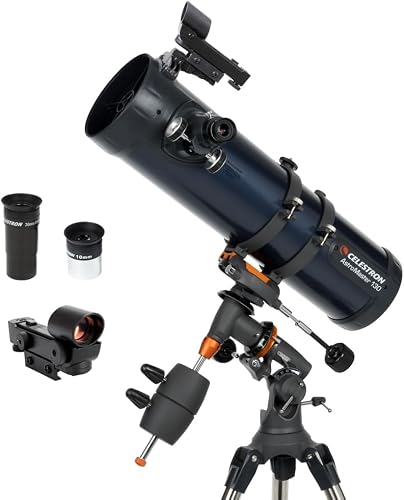
Celestron AstroMaster 130EQ Telescope
A 130mm reflector on an equatorial mount with thousands of owner ratings. Good optics for the price if you will learn the mount.
- Aperture
- 130 mm
- Design
- Newtonian reflector
- Mount
- Equatorial
What works
- Large aperture for the price
- Shows the Moon, planets and brighter deep-sky objects
- Widely sold with strong owner feedback
Watch for
- Equatorial mount takes time to learn
- Not as portable as a small refractor
Best for: a first telescope with real light-gathering power
Celestron Inspire 100AZ: easiest for families
The Inspire 100AZ is a 100mm refractor on a simple alt-azimuth tripod. Refractors have a sealed tube, so there is no mirror to align and almost no maintenance. The views of the Moon and planets are crisp, and it is easy to hand to someone else for a turn at the eyepiece.
Because the aperture is smaller than the reflectors here, faint objects are limited. Check the listing for the accessories included, since they vary by version. For a family scope that just works, it earns a place.
Buy it if you want a low-maintenance refractor for the whole family. Skip it if you want deep-sky views.
Easiest for families

Celestron Inspire 100AZ Refractor Telescope
A 100mm refractor on a simple tripod. Sharp, low-maintenance views of the Moon and planets with almost no learning curve.
- Aperture
- 100 mm
- Design
- Refractor
- Mount
- Alt-azimuth
What works
- Simple point-and-look mount
- Good for Moon and planets
- Phone adapter makes sharing views easy
Watch for
- Smaller aperture limits faint objects
- Mount can feel light at high power
Best for: easy setup with smartphone-friendly design
Side-by-side specs
| Model | Aperture | Design | Mount | Price |
|---|---|---|---|---|
| Sky-Watcher Heritage 150 Tabletop Dobsonian | 150 mm (6 inch) | Collapsible tabletop Dobsonian | Manual tabletop alt-azimuth | From about $309 |
| Celestron StarSense Explorer DX 130AZ Telescope | 130 mm | Newtonian reflector | Alt-azimuth with app guidance | From about $500 |
| Celestron StarSense Explorer LT 114AZ | 114 mm (4.5 inch) | Newtonian reflector | Alt-azimuth with StarSense app | From about $240 |
| Celestron AstroMaster 130EQ Telescope | 130 mm | Newtonian reflector | Equatorial | From about $290 |
| Celestron Inspire 100AZ Refractor Telescope | 100 mm | Refractor | Alt-azimuth | From about $340 |
Mistakes that waste a small telescope budget
Spending it on accessories. A bundle of extra lenses and filters does not fix a weak mount or small mirror. Put the money in the scope.
Buying a scope that is too heavy to use. A great mirror in the closet shows you nothing. Be honest about how often you will carry it out.
Ignoring the mount. Many cheap scopes pair a fine tube with a flimsy tripod. You see the shake every time you touch it.
Buying for magnification. The best magnification is whatever the air and the aperture allow. For a sense of what is realistic, read what you can see through a telescope in our guide.
Quick tips for your first week
Set up in daylight and align the finder on a distant object. Start with the Moon. Use the lowest-power eyepiece first. Let the scope cool for 20 to 30 minutes outdoors. Our how to use a telescope guide has the full routine.
What you will actually see at this budget
It helps to set expectations before the first night. On the Moon, any scope here shows craters, mountain ranges and the dark plains in sharp relief, and the terminator, the line between day and night on the Moon, is the best place to look because the shadows are long. On Jupiter you will see the cloud bands and the four bright moons lined up beside it. On Saturn you will see the rings clearly, even in the smaller scopes, though the gap in the rings takes steadier air and more aperture.
Deep-sky objects are where aperture earns its keep. The Orion Nebula, the Pleiades and the Andromeda Galaxy are all within reach of these telescopes, and they look like faint gray clouds rather than colorful photographs. That surprises people the first time. The colors in published images come from long exposures, and your eye cannot build up light the way a camera sensor does. Larger mirrors, like the 6-inch in the Heritage 150, show noticeably more structure than a 100mm refractor.
Eyepieces, finders and the small stuff
Most scopes at this price include two eyepieces, usually a longer focal length for wide views and a shorter one for higher power. Start with the longer one. A low-power, wide view is easier to aim and shows more sky, and it is the setting you will use most. Use the shorter eyepiece on the Moon and planets once you have the object centered.
The finder matters more than people expect. A red-dot finder is easy to use because you look through it with both eyes open and see a dot on the sky. A small finder scope gives a magnified view but takes practice. Whichever you get, align it in daylight on a distant object so that the same object sits in the main eyepiece. That five-minute step saves frustration on the first night.
Our eyepiece guide explains how to choose upgrades later, and it is worth reading before you spend anything on extras.
A simple way to choose between the five
Ask yourself two questions. First, how will you find things: by hand with a Dobsonian, with the help of an app or with the old-school learn-the-mount route? Second, where will the scope live: in a closet that fits a small tube, or in a corner where a bigger one can stay set up? Answer those honestly and the choice usually makes itself. The Heritage 150 wins for views and storage, the StarSense scopes win for guided finding, the AstroMaster 130EQ wins for people who like to learn a traditional mount, and the Inspire 100AZ wins for hands-off family use.
Looking for a gift? See our telescope gift guide, and for a brand comparison see Celestron vs Sky-Watcher.
How we chose these telescopes
We looked at telescopes commonly sold on Amazon under this budget and compared aperture, mount design, how you find objects and how many buyers have rated each one. We leaned toward scopes with a long record and large owner feedback, and we included different styles so there is a fit for different goals. This is research, not hands-on testing. Prices come from Amazon and are stamped with the time they were checked. See our about page and affiliate disclosure for how we work.
If your budget is tighter than this list assumes, our guide to the best affordable telescopes covers the cheaper end.
Which one should you buy?
If views are the priority, buy the Heritage 150. If finding objects is the worry, buy the StarSense DX 130AZ, or the LT 114AZ if you need to spend less. The AstroMaster 130EQ suits patient hobbyists, and the Inspire 100AZ suits families who want a no-fuss refractor. For the full picture, start at our beginner telescope list.
Frequently asked questions
Is $500 enough for a good telescope?
Yes. A 6-inch Dobsonian or a 130mm reflector gives you real views of the Moon, planets and brighter deep-sky objects. Spending more mostly buys convenience such as motors and tracking.
Should I buy a cheap telescope under $200?
Be careful. Scopes at the very bottom of the range often have wobbly mounts and optics that cannot support the magnification on the box. Stepping up to a better scope usually pays off.
Which is better under $500, a refractor or a reflector?
For the money, a reflector gives you more aperture. A refractor needs less care and handles well, so it suits families who want low maintenance.
Do I need to buy extra eyepieces?
Not at first. The included eyepieces are usable for the Moon and planets. Upgrading them later helps, and our eyepiece guide explains when.
Can I take pictures with these?
You can take phone photos of the Moon and brighter planets through the eyepiece. Deep-sky photos need a tracking setup and more gear.
What is the best type of telescope under 500 dollars?
A 6-inch or 8-inch Dobsonian generally gives the best views for the money. A small GoTo or refractor suits people who want ease or portability.
How big a Dobsonian can I get for this budget?
Usually up to 8 inches. Some sales bring a 10-inch within reach, though it is bulkier.
Are eyepieces included at this price?
Most telescopes include one or two basic eyepieces. They work to start with, and a better eyepiece is the first upgrade to consider.
Keep reading
Best Telescopes Best Telescopes for Beginners: Five Picks That Show Real Detail Five beginner telescopes compared by aperture, mount, setup and price, with plain advice on what you will actually see and who should skip each one. 10 min read · Updated Oct 17, 2026 Best Telescopes Best Telescopes for the Money: Five Scopes With the Best Value Five telescopes ranked by what you get for the money, from a 6-inch tabletop Dobsonian to app-guided and GoTo scopes, with honest notes on the trade-offs. 8 min read · Updated Oct 29, 2026 Beginners, Kids and Budget Best Telescopes for Kids: Five That Hold Their Interest Five telescopes for kids and families, picked for easy setup and real views of the Moon and planets, with honest notes on what to avoid in a toy scope. 8 min read · Updated Oct 19, 2026