
Best Telescopes Under $1,000: Five Scopes That Reward a Bigger Budget

A budget near a thousand dollars changes what you can buy. At this level you can step past starter scopes and get either a large-aperture Dobsonian or a computerized GoTo scope from a major brand. The question is which of those matters to you, since you rarely get both at this price.
This guide covers five scopes that fit the range, and what the extra money buys compared with a lower-cost scope. If your budget is lower, our telescopes under $500 list is the place to start.
Quick comparison
- 1
Best views for the money
Sky-Watcher Flextube 200 Collapsible Dobsonian (8-inch)203 mm (8 inch) · Collapsible Dobsonian reflector · Manual alt-azimuth
From about $739Check price - 2
Best computerized scope
Celestron NexStar 5SE Telescope125 mm · Schmidt-Cassegrain · Computerized alt-azimuth GoTo
From about $899Check price - 3
Best guided tabletop
Celestron StarSense Explorer 150mm Tabletop Dobsonian150 mm (6 inch) · Tabletop Dobsonian · Manual tabletop with StarSense app
From about $510Check price - 4
Best guided reflector
Celestron StarSense Explorer DX 130AZ Telescope130 mm · Newtonian reflector · Alt-azimuth with app guidance
From about $500Check price - 5
Best value if you want to spend less
Sky-Watcher Heritage 150 Tabletop Dobsonian150 mm (6 inch) · Collapsible tabletop Dobsonian · Manual tabletop alt-azimuth
From about $309Check price
Links go to Amazon. Prices shown are the last ones we checked and change often.
What a bigger budget actually buys
There are three things extra money can buy in a telescope.
More aperture. An 8-inch scope gathers about 80 percent more light than a 6-inch, and the improvement is clear on planets and faint objects.
Convenience. Computerized GoTo mounts find and track objects for you. App-guided scopes help you find them by hand.
Better build. Sturdier mounts and better focusers make a scope more pleasant to use.
Money does not buy better views from a bright city, and it does not make a scope better at photography unless the mount is right. Our guide to choosing a telescope helps you work out which of the three you want.
The five picks
Sky-Watcher Flextube 200: best views for the money
An 8-inch Dobsonian with a collapsible tube, the Flextube 200 sits comfortably under this budget and delivers more light than any other scope on the list. Planets show finer detail, and galaxies and nebulae that look marginal in smaller scopes become clear. The mount is stable and simple.
There is no tracking and no app, so you find objects by hand. If you want the best images for the least money, this is the one.
Buy it if you want maximum light for the money. Skip it if you want automatic finding or tracking.
Best views for the money
Sky-Watcher Flextube 200 Collapsible Dobsonian (8-inch)
An 8-inch collapsible Dobsonian. The best light-gathering value here, with a simple stable mount.
- Aperture
- 203 mm (8 inch)
- Design
- Collapsible Dobsonian reflector
- Mount
- Manual alt-azimuth
What works
- Large 8-inch aperture for deep-sky and planets
- Collapsible tube is easier to store and carry
- Simple manual mount with no setup
Watch for
- Costs more than a fixed-tube 8-inch Dobsonian
- Few buyer ratings on the listing
Best for: people who want 8 inches of aperture in a storable package
Celestron NexStar 5SE: best computerized scope
The 5SE is a compact 5-inch scope on a computerized mount. It finds and tracks thousands of objects after a short alignment. The tracking keeps targets centered at high power, and the compact design is easy to move.
It costs less than the 8SE and shows less, but for many people the convenience is what makes it worth buying. See telescopes that find objects for you for how it compares with app-guided options.
Buy it if you want automatic finding and tracking in a compact scope. Skip it if you want the most aperture.
Best computerized scope

Celestron NexStar 5SE Telescope
A compact 5-inch GoTo scope that finds and tracks thousands of objects. It sits comfortably under this budget.
- Aperture
- 125 mm
- Design
- Schmidt-Cassegrain
- Mount
- Computerized alt-azimuth GoTo
What works
- Compact and portable
- GoTo mount saves time
- Sharp views of the Moon and planets
Watch for
- Smaller aperture than the 8SE
- Higher price than basic scopes
Best for: portable GoTo with good optics
Celestron StarSense Explorer 150mm Tabletop: best guided tabletop
This 150mm tabletop Dobsonian adds phone-guided finding to a light, simple design. You get the benefits of a Dobsonian, a large mirror and a stable base, with help for finding targets. It is easy to carry and quick to set up.
It sits on a table, and there is no tracking. It costs more than the unguided version, so you are paying for the app.
Buy it if you want a portable scope with guided finding. Skip it if you want to save money.
Best guided tabletop
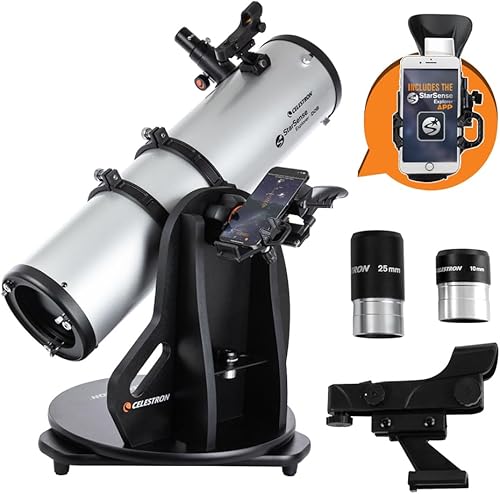
Celestron StarSense Explorer 150mm Tabletop Dobsonian
A 150mm tabletop Dobsonian with phone-guided finding. Light and simple, with help for the hard part.
- Aperture
- 150 mm (6 inch)
- Design
- Tabletop Dobsonian
- Mount
- Manual tabletop with StarSense app
What works
- 6-inch aperture at a mid-range price
- Phone app helps you find targets
- Compact and easy to carry
Watch for
- Needs a table or sturdy surface
- No tracking
Best for: an app-guided scope you can carry
Celestron StarSense Explorer DX 130AZ: best guided reflector
The DX 130AZ is a 130mm reflector with the StarSense app. It is a step up from the entry StarSense scopes in aperture, and it sits at a moderate price. You push the scope by hand, and the app tells you where to point.
It suits people who want guidance without paying GoTo prices. It is also a pick in telescopes under $500.
Buy it if you want guided finding at a moderate cost. Skip it if you want tracking.
Best guided reflector

Celestron StarSense Explorer DX 130AZ Telescope
A 130mm reflector with phone-guided finding. A good middle option at this budget.
- Aperture
- 130 mm
- Design
- Newtonian reflector
- Mount
- Alt-azimuth with app guidance
What works
- Phone app guides you to targets
- Good light-gathering for the price
- Removes much of the star-hopping frustration
Watch for
- Needs a compatible smartphone
- Not a motorized tracker
Best for: beginners who want help finding objects
Sky-Watcher Heritage 150: best value if you want to spend less
If you do not need to spend a thousand dollars, the Heritage 150 shows how far a smaller budget goes. A 6-inch collapsible tabletop Dobsonian shows planets and many deep-sky objects at a much lower cost. You can spend the difference on a better eyepiece or a trip to a dark site.
It is a good reminder that more money does not always mean better views. See best telescopes for the money.
Buy it if you want to keep costs low. Skip it if you want guided finding or tracking.
Best value if you want to spend less

Sky-Watcher Heritage 150 Tabletop Dobsonian
A 6-inch collapsible Dobsonian at a much lower cost. You can spend far less and still see a lot.
- Aperture
- 150 mm (6 inch)
- Design
- Collapsible tabletop Dobsonian
- Mount
- Manual tabletop alt-azimuth
What works
- 6-inch aperture at a low price
- Collapsible and light to carry
- No assembly puzzle or alignment
Watch for
- Needs a table or stable surface
- No tracking, so you nudge it by hand
Best for: a low-cost, no-fuss first telescope
Side-by-side specs
| Model | Aperture | Design | Mount | Price |
|---|---|---|---|---|
| Sky-Watcher Flextube 200 Collapsible Dobsonian (8-inch) | 203 mm (8 inch) | Collapsible Dobsonian reflector | Manual alt-azimuth | From about $739 |
| Celestron NexStar 5SE Telescope | 125 mm | Schmidt-Cassegrain | Computerized alt-azimuth GoTo | From about $899 |
| Celestron StarSense Explorer 150mm Tabletop Dobsonian | 150 mm (6 inch) | Tabletop Dobsonian | Manual tabletop with StarSense app | From about $510 |
| Celestron StarSense Explorer DX 130AZ Telescope | 130 mm | Newtonian reflector | Alt-azimuth with app guidance | From about $500 |
| Sky-Watcher Heritage 150 Tabletop Dobsonian | 150 mm (6 inch) | Collapsible tabletop Dobsonian | Manual tabletop alt-azimuth | From about $309 |
How to choose between a Dobsonian and a GoTo scope
The two main paths at this budget are a large Dobsonian and a computerized scope, and they suit different people.
A Dobsonian suits someone who wants to see as much as possible, enjoys the process of finding objects and has room to store a larger scope. You learn the sky, and your skills carry over to every scope you own later. The Flextube 200 is the best example here.
A computerized scope suits someone who wants to spend the night looking instead of searching, who shares the scope with others or who has limited time. The NexStar 5SE does the finding and tracking, and a short alignment is all it needs. You pay for that convenience with less aperture for the money.
App-guided scopes sit in the middle. They do not track, but they tell you where to point. If you are torn, the guided scopes are the lower-risk choice, since they cost less and need no power.
Eyepieces and extras worth the money
At this budget, a single good eyepiece can make a bigger difference than any other accessory. A wide-field, low-power eyepiece makes finding objects easier and shows more of large clusters and nebulae. A good mid-power eyepiece improves planetary views. Our eyepiece guide explains what to look for.
A red flashlight, a comfortable observing chair and a star chart or app are cheap and useful. A collimation tool is worth having if you buy a reflector. See how to collimate a Newtonian telescope for the details.
Expectations at this level
With a scope in this range, you will see Saturn's rings and the Cassini Division on a good night, Jupiter's cloud belts and the Great Red Spot, the phases of Venus and detail on the Moon that rewards hours of looking. Under dark skies you will see dozens of galaxies and nebulae, though as faint glows rather than photographs. Setting that expectation will keep you happy.
What to avoid at this budget
Spending on accessories first. A better eyepiece helps, but a bundle of extras does not fix a small mirror.
Buying a GoTo scope for photography. Alt-azimuth GoTo scopes are limited for long exposures. See astrophotography gear for what suits photos.
Ignoring storage. A larger scope needs room.
Skipping dark skies. A good scope in a bright backyard shows less than you hope. Plan an occasional trip to a darker site.
When to go bigger than 8 inches
If you have the room and a car, a 10-inch Dobsonian opens up a lot more of the deep sky. It sits above this budget in some versions, and it is worth a look at large aperture telescopes.
Warranty and buying tips
When you spend this much, buy from a seller that offers a return window, and test the scope soon after it arrives. Inspect the box for damage when it comes, and check that all parts are present. Test the focuser, the mount and the finder on the first clear night. If something is wrong, ask for a replacement quickly, while the window is open.
Keep the box and packing for a while. Large scopes are hard to repack, and the original box is the best protection if you ever need to ship or move it. Save the receipt and the manual too.
How we chose these telescopes
We compared aperture, mount, how objects are found, portability and owner feedback on the listings. This is research, not hands-on testing. Prices come from Amazon and are stamped with the time they were checked. See our about page and affiliate disclosure.
Which one should you buy?
Buy the Flextube 200 for the best views, the NexStar 5SE for computerized convenience, one of the StarSense scopes for app guidance and the Heritage 150 if you would rather keep spending low. For the full range, see our beginner telescope list.
Frequently asked questions
Is a telescope worth $1,000?
It can be, if it matches how you will use it. Under that budget you can buy a large Dobsonian or a computerized GoTo scope, and either is a real step up from a starter.
What is the best telescope under $1,000 for deep-sky?
An 8-inch Dobsonian is hard to beat for the money. Dark skies matter as much as the scope.
Should I buy a GoTo scope at this budget?
If finding objects is what would make you quit, yes. If you enjoy learning the sky or want the most aperture, a Dobsonian is better value.
Can I take photos with these?
Phone photos of the Moon and planets are easy. Long-exposure deep-sky photos need a different mount and more gear.
Do I need to spend this much?
No. A 6-inch Dobsonian costs far less and shows a lot. Spend more when you know what you want to add.
What can I see with a telescope under 1000 that I cannot with a cheaper one?
More faint detail in galaxies and nebulae, sharper planets, and better tracking. A larger aperture and a better mount are what the extra money buys.
Is a Schmidt-Cassegrain a good choice at this budget?
Yes if you want a compact, GoTo-capable scope with long focal length. It is great for planets and portable, but a Dobsonian gives more aperture for the money.
Should I buy a telescope or a camera setup at this price?
If you mainly want to look, buy the telescope. If photos are the goal, a tracking mount and a camera may serve you better. Photography adds a lot to the total cost.
Keep reading
Beginners, Kids and Budget Best Telescopes Under $500: Five That Are Worth Buying Five telescopes under $500, from a tabletop Dobsonian to app-guided reflectors, with honest notes on what each one shows and what you give up. 9 min read · Updated Oct 18, 2026 Best Telescopes Best Telescopes for the Money: Five Scopes With the Best Value Five telescopes ranked by what you get for the money, from a 6-inch tabletop Dobsonian to app-guided and GoTo scopes, with honest notes on the trade-offs. 8 min read · Updated Oct 29, 2026 Types and Mounts Best Telescopes That Find Objects for You: GoTo and App-Guided Computerized GoTo and phone-guided telescopes compared, with honest advice on which type of automatic finding is worth paying for and who should skip it. 8 min read · Updated Oct 21, 2026