Best Telescopes for Kids: Five Scopes They Will Actually Use

A kid's first look at Saturn is the sort of thing that sticks with them. The rings are small, but they are really there, and a child who sees them often asks for another look the next night. The best telescope for a child is the one that makes that moment easy.
That means a scope that is quick to set up, steady when touched and simple enough that a kid does not need a parent for every step. It also means skipping the toy telescopes that promise huge magnification and deliver a shaky, dim image. If you are shopping for a gift, our telescope gift guide has more.
Quick comparison
- 1From about $340Check price
- 2From about $97Check price
- 3
Best for kids who like gadgets
Celestron StarSense Explorer LT 114AZ114 mm (4.5 inch) · Newtonian reflector · Alt-azimuth with StarSense app
From about $240Check price - 4
Best if they get serious
Sky-Watcher Heritage 150 Tabletop Dobsonian150 mm (6 inch) · Collapsible tabletop Dobsonian · Manual tabletop alt-azimuth
From about $309Check price - 5
Best for a teen who wants to learn
Celestron AstroMaster 130EQ Telescope130 mm · Newtonian reflector · Equatorial
From about $290Check price
Links go to Amazon. Prices shown are the last ones we checked and change often.
What to look for in a kids' telescope
A stable mount. The main complaint with cheap scopes is shaking. A kid who sees the image jump will give up.
Easy aiming. Look for a finder or a red-dot sight that works, since a kid needs to put the Moon in the eyepiece without help.
Light enough to carry. A heavy scope stays inside. Lightweight designs get used.
Honest aperture. A scope with 70 to 130 millimeters of aperture is plenty for early nights. See our guide to choosing a telescope for the full rundown.
The five picks
Celestron Inspire 100AZ: easiest all-round pick
The Inspire 100AZ is a 100mm refractor with a sealed tube, which means no mirror to align and almost no maintenance. It goes on a simple alt-azimuth tripod, so aiming is up, down and sideways. The views of the Moon are crisp enough to make a child stop and stare.
The aperture is smaller than a reflector's, so faint galaxies are out of reach, but planets and the Moon are where kids start anyway. Check the listing for what is included.
Buy it if you want a low-effort scope the whole family can use. Skip it if your child wants deep-sky objects.
Easiest all-round pick
Celestron Inspire 100AZ Refractor Telescope
A 100mm refractor on a simple tripod. Sealed tube, sharp Moon and planet views, and almost nothing to learn.
- Aperture
- 100 mm
- Design
- Refractor
- Mount
- Alt-azimuth
What works
- Simple point-and-look mount
- Good for Moon and planets
- Phone adapter makes sharing views easy
Watch for
- Smaller aperture limits faint objects
- Mount can feel light at high power
Best for: easy setup with smartphone-friendly design
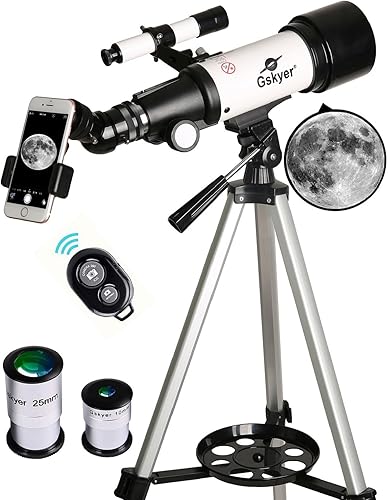
Gskyer 70mm AZ Refractor: lowest-cost starter
The Gskyer 70mm is the budget option. It has an enormous number of ratings on the listing, which tells you how many families have bought one. It is light, and the setup is quick. It comes with extras such as a phone adapter and remote, according to the listing, which kids tend to enjoy.
The aperture is small and the mount is light, so it can wobble. It is fine for the Moon and bright planets. If the interest sticks, you will likely upgrade.
Buy it if you want to try astronomy for as little as possible. Skip it if you want sharp planetary detail.
Lowest-cost starter
Gskyer 70mm AZ Refractor Telescope
A 70mm refractor with a very large number of buyer ratings. Fine for the Moon and bright planets, and light for small hands.
- Aperture
- 70 mm
- Design
- Refractor
- Mount
- Alt-azimuth
What works
- Very low price
- Light and quick to set up
- Fine for the Moon and bright planets
Watch for
- Limited light-gathering
- Lightweight mount can wobble
Best for: a very low-cost starter
Celestron StarSense Explorer LT 114AZ: best for kids who like gadgets
A phone docks onto the LT 114AZ, and the app guides you to objects on screen. Kids who grew up with tablets take to it fast. Instead of an hour of hunting, they get a list of targets and arrows. The 114mm mirror shows the Moon, planets and bright clusters.
It needs a phone, and the mount is lightweight. For a child who needs quick wins, it is a good motivator. See also telescopes that find objects for you.
Buy it if a guided, app-driven experience fits your child. Skip it if you want to limit screen time at night.
Best for kids who like gadgets

Celestron StarSense Explorer LT 114AZ
A 114mm reflector that uses a phone to guide you to targets. Kids who like apps get to the good stuff quickly.
- Aperture
- 114 mm (4.5 inch)
- Design
- Newtonian reflector
- Mount
- Alt-azimuth with StarSense app
What works
- Phone app guides you to targets
- Low price for the feature
- Very popular with first-time buyers
Watch for
- Small aperture limits faint objects
- Light mount needs careful handling
Best for: the lowest-cost app-guided scope
Sky-Watcher Heritage 150: best if they get serious
If a child is keen, the Heritage 150 is a scope they will not outgrow soon. A 6-inch mirror shows much more than a small refractor, and the collapsible tabletop design keeps it light and easy to store. It has no electronics to fail.
It needs a table or stable surface, and it takes a little practice to aim. For an older child who wants to see more, it is hard to beat for the money.
Buy it if your child has shown real interest. Skip it if you want a no-learning-curve scope for a younger kid.
Best if they get serious

Sky-Watcher Heritage 150 Tabletop Dobsonian
A 6-inch tabletop Dobsonian that shows far more than a small scope. A strong choice for a young observer who sticks with it.
- Aperture
- 150 mm (6 inch)
- Design
- Collapsible tabletop Dobsonian
- Mount
- Manual tabletop alt-azimuth
What works
- 6-inch aperture at a low price
- Collapsible and light to carry
- No assembly puzzle or alignment
Watch for
- Needs a table or stable surface
- No tracking, so you nudge it by hand
Best for: a low-cost, no-fuss first telescope
Celestron AstroMaster 130EQ: best for a teen who wants to learn
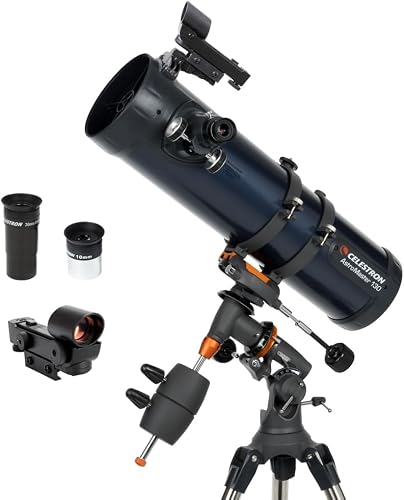
The AstroMaster 130EQ puts a 130mm reflector on an equatorial mount. A teen who likes learning how things work will enjoy figuring it out, and the views reward the effort. Thousands of buyers have rated it.
It is heavier and fussier than a refractor and the mount has a learning curve, so it is not the right scope for a young child.
Buy it if your teen wants a traditional telescope to learn on. Skip it if you want grab-and-go simplicity.
Best for a teen who wants to learn
Celestron AstroMaster 130EQ Telescope
A 130mm reflector on an equatorial mount. More to learn, with better views once they get the hang of it.
- Aperture
- 130 mm
- Design
- Newtonian reflector
- Mount
- Equatorial
What works
- Large aperture for the price
- Shows the Moon, planets and brighter deep-sky objects
- Widely sold with strong owner feedback
Watch for
- Equatorial mount takes time to learn
- Not as portable as a small refractor
Best for: a first telescope with real light-gathering power
Side-by-side specs
| Model | Aperture | Design | Mount | Price |
|---|---|---|---|---|
| Celestron Inspire 100AZ Refractor Telescope | 100 mm | Refractor | Alt-azimuth | From about $340 |
| Gskyer 70mm AZ Refractor Telescope | 70 mm | Refractor | Alt-azimuth | From about $97 |
| Celestron StarSense Explorer LT 114AZ | 114 mm (4.5 inch) | Newtonian reflector | Alt-azimuth with StarSense app | From about $240 |
| Sky-Watcher Heritage 150 Tabletop Dobsonian | 150 mm (6 inch) | Collapsible tabletop Dobsonian | Manual tabletop alt-azimuth | From about $309 |
| Celestron AstroMaster 130EQ Telescope | 130 mm | Newtonian reflector | Equatorial | From about $290 |
Tips that keep kids interested
Start with the Moon. It is bright, easy to find and different every night. Then try Jupiter and Saturn when they are up. Keep sessions short, since a cold, tired child is not going to stay out for an hour. Bring a blanket and a red flashlight, and let them do the focusing and aiming themselves. Our how to use a telescope guide covers the routine, and what you can see through a telescope helps set expectations so there are no letdowns.
A safety rule worth repeating
Never let a child look at the Sun through a telescope without a certified solar filter made for that purpose. The damage can be immediate and permanent. If you want to show your child an eclipse or sunspots, read how to view the Sun safely first.
How to pick between a refractor and a reflector for a child
Refractors use a lens at the front, and the tube is sealed. That makes them tough and low-maintenance, which suits a child who might knock a scope or leave it in a cold car. Reflectors use a mirror and are open at one end, so they give more aperture for the money but sometimes need a quick alignment. For a young child, a refractor like the Inspire 100AZ is easier. For an older, keener child, a reflector like the Heritage 150 shows more. Our guide to refractor vs reflector telescopes explains the difference in more detail.
What a child will realistically see
Set expectations early, because a child who expects Hubble pictures will be let down. The Moon is the star of the show, and kids tend to love it. Jupiter's moons, which change position from night to night, are a great hook, because you can say "go look again tomorrow and see what moved." Saturn's rings usually bring the biggest reaction. Star clusters like the Pleiades are easy and pretty.
Galaxies and nebulae look like faint smudges, and a child may not find that thrilling. Do not lead with them. Save them for when the child has already caught the bug. Our guide on what you can see through a telescope lists the best first targets.
Making it a family habit
The telescopes that get used are the ones that are easy to take out. Keep the scope somewhere it can be grabbed in a minute, and learn a few targets so that each night has a goal. Check an app for what is up, and make a list of three things to find. When a child finds something alone, they remember it.
It also helps to start before the cold season catches you out. Warm clothes matter more than any piece of gear on a winter night, and a thermos of something hot does wonders for a kid's patience. If you are shopping for the holidays, see our telescope gift guide, which covers what to buy and what to skip.
If you plan to show your child the Sun, buy a proper filter first. Our guide to solar filters for telescopes lists the options and the safety checks.
How we chose these telescopes
We compared popular telescopes sold on Amazon for beginners and families, looking at weight, mount stability, ease of aiming, aperture and how many buyers have rated each one. This is research, not hands-on testing. Prices come from Amazon and are stamped with the time they were checked, so confirm before buying. Our about page and affiliate disclosure explain how we work.
Which one should you buy?
For most families, the Inspire 100AZ is the easiest pick. The Gskyer 70mm is the budget way to try it, the StarSense LT 114AZ suits gadget-loving kids and the Heritage 150 is the one that grows with a keen child. For a broader look, start with our beginner telescope list.
Frequently asked questions
What age is a telescope good for?
Many kids enjoy a first telescope from around eight or nine, with an adult helping. Younger children can look through one, but they need help aiming it.
What size telescope is best for a child?
A 70 to 100mm scope is easy to handle. If the child is older and keen, a 6-inch tabletop Dobsonian gives much better views and still weighs little.
Are cheap kids telescopes any good?
The very cheapest ones are often disappointing, with weak mounts and blurry views. Spending a bit more on a stable scope from a known brand pays off.
Can kids see planets with a telescope?
Yes. Saturn's rings and Jupiter's moons are within reach of even small scopes, and kids tend to remember the first time.
Is it safe for kids to use a telescope?
Yes, with one firm rule: never look at the Sun through a telescope without a certified solar filter. Read our solar safety guide first.
Should a kid get a telescope or binoculars?
Binoculars are easier for young children. Once they are around eight or older, a simple telescope that is quick to set up keeps them engaged.
How do I keep a child interested in astronomy?
Start with easy targets like the Moon and bright planets, use a red light, and make observing short and fun. A simple star app helps them find constellations.
What features make a telescope kid-friendly?
A stable mount, a simple finder, low weight, and easy focus. Avoid toy telescopes with plastic lenses and wobbly mounts.
Keep reading
Best Telescopes Best Telescopes for Beginners: Five Picks That Show Real Detail Five beginner telescopes compared by aperture, mount, setup and price, with plain advice on what you will actually see and who should skip each one. 10 min read · Updated Oct 17, 2026 Beginners, Kids and Budget Best Telescopes as Gifts: Five Picks That Get Used Five telescopes that make good gifts for kids, teens and adults, picked for easy setup and real views, plus what to avoid and how to match the scope to the person. 8 min read · Updated Nov 1, 2026 Beginners, Kids and Budget Best Telescopes Under $500: Five That Are Worth Buying Five telescopes under $500, from a tabletop Dobsonian to app-guided reflectors, with honest notes on what each one shows and what you give up. 9 min read · Updated Oct 18, 2026