Best Dobsonian Telescopes: Four Picks From Tabletop to 10-Inch

If someone says the best telescope for the money is a Dobsonian, they are right, and the reason is simple. A Dobsonian skips motors, fancy mounts and extras and puts all the money into the mirror. A bigger mirror gathers more light, and more light means better views of the Moon, planets, star clusters, galaxies and nebulae.
The trade-offs are size and the lack of tracking. This list covers four Dobsonians at different sizes so you can match one to your car, your storage and your patience. If you are still working out which kind of scope suits you, our beginner telescope list is the place to start.
Quick comparison
- 1
Best all-round Dobsonian
Sky-Watcher Flextube 200 Collapsible Dobsonian (8-inch)203 mm (8 inch) · Collapsible Dobsonian reflector · Manual alt-azimuth
From about $739Check price - 2
Best budget and portable
Sky-Watcher Heritage 150 Tabletop Dobsonian150 mm (6 inch) · Collapsible tabletop Dobsonian · Manual tabletop alt-azimuth
From about $309Check price - 3
Best tabletop with app help
Celestron StarSense Explorer 150mm Tabletop Dobsonian150 mm (6 inch) · Tabletop Dobsonian · Manual tabletop with StarSense app
From about $510Check price - 4
Best for the most light
Celestron StarSense Explorer 10" App-Enabled Dobsonian254 mm (10 inch) · Dobsonian reflector · Manual alt-azimuth with StarSense app
From about $1,199Check price
Links go to Amazon. Prices shown are the last ones we checked and change often.
How a Dobsonian works, in plain terms
The scope sits on a wooden or composite base that pivots up and down and swings left and right. That is the entire mount. There is no equatorial head to align and no electronics to configure. You set the scope on the ground, point it by hand and look.
That simplicity is the main attraction. It is also why a Dobsonian is stable, since the heavy base sits low. When you touch the focuser, the view settles quickly. The reflector design inside is the same one you will read about in refractor vs reflector telescopes.
What you give up
Tracking. Without a motor, objects drift out of view, and the higher the magnification, the faster they go. You learn to nudge the scope.
Photography. Dobsonians are great for visual use. Long exposures are not their game.
Size. A big mirror is a big tube. Plan for storage and transport, and see large aperture telescopes for the biggest options.
The four picks
Sky-Watcher Flextube 200: best all-round Dobsonian
The Flextube 200 is an 8-inch Dobsonian with a collapsible tube. The mirror gathers about 80 percent more light than a 6-inch, so planets, the Moon and many deep-sky objects look noticeably better. With the tube collapsed, it is shorter and easier to store than a traditional fixed-tube 8-inch.
It costs more than the tabletop models and it is still a sizable scope, so plan on room for it and a car for trips to dark skies. For most buyers who can stretch, it is the sweet spot.
Buy it if you want strong views and have space. Skip it if you need something small or you are tight on budget.
Best all-round Dobsonian
Sky-Watcher Flextube 200 Collapsible Dobsonian (8-inch)
An 8-inch collapsible Dobsonian. A big step up in light over small scopes, with a tube that shortens for storage.
- Aperture
- 203 mm (8 inch)
- Design
- Collapsible Dobsonian reflector
- Mount
- Manual alt-azimuth
What works
- Large 8-inch aperture for deep-sky and planets
- Collapsible tube is easier to store and carry
- Simple manual mount with no setup
Watch for
- Costs more than a fixed-tube 8-inch Dobsonian
- Few buyer ratings on the listing
Best for: people who want 8 inches of aperture in a storable package
Sky-Watcher Heritage 150: best budget and portable
The Heritage 150 is a 6-inch tabletop Dobsonian with a collapsible tube. It is low in price and light enough to carry in one hand with the tube collapsed. Saturn's rings, Jupiter's bands and a lot of star clusters look good in it.
It sits on a table or sturdy box, so you need a stable surface. It is also a strong choice for telescopes under $500.
Buy it if you want the most light for the least money in a small package. Skip it if you want to stand the scope on the ground and observe at eye level.
Best budget and portable

Sky-Watcher Heritage 150 Tabletop Dobsonian
A 6-inch collapsible tabletop Dobsonian. A low cost and very easy to carry, with real views of planets and star clusters.
- Aperture
- 150 mm (6 inch)
- Design
- Collapsible tabletop Dobsonian
- Mount
- Manual tabletop alt-azimuth
What works
- 6-inch aperture at a low price
- Collapsible and light to carry
- No assembly puzzle or alignment
Watch for
- Needs a table or stable surface
- No tracking, so you nudge it by hand
Best for: a low-cost, no-fuss first telescope
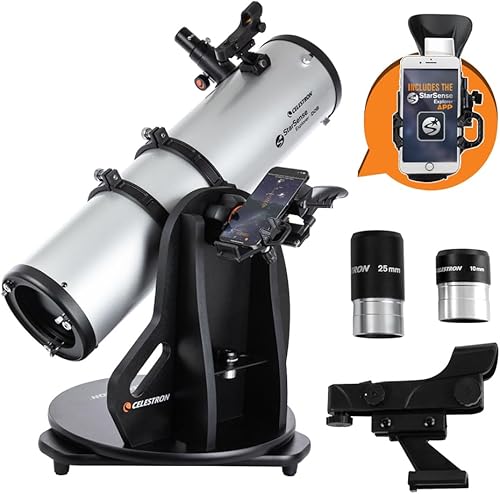
Celestron StarSense Explorer 150mm Tabletop: best tabletop with app help
This 150mm tabletop Dobsonian adds the StarSense app to a simple, light scope. You dock your phone, and the app helps you find objects. It means the good parts of a Dobsonian, a big mirror and a simple mount, arrive with a guide for the hard part.
It costs more than the Heritage 150, so you are paying for the app. If finding objects is your worry, that can be money well spent.
Buy it if you want a Dobsonian with guided finding. Skip it if you prefer to learn the sky by hand and save money.
Best tabletop with app help
Celestron StarSense Explorer 150mm Tabletop Dobsonian
A 150mm tabletop Dobsonian with StarSense phone-guided finding. It adds guidance to a simple, light scope.
- Aperture
- 150 mm (6 inch)
- Design
- Tabletop Dobsonian
- Mount
- Manual tabletop with StarSense app
What works
- 6-inch aperture at a mid-range price
- Phone app helps you find targets
- Compact and easy to carry
Watch for
- Needs a table or sturdy surface
- No tracking
Best for: an app-guided scope you can carry
Celestron StarSense Explorer 10-inch: best for the most light
The 10-inch is the largest scope on this list, and it shows. Ten inches of aperture brings out fainter galaxies and nebulae, finer planetary detail and more stars in a cluster. Phone-guided finding makes the big sky less intimidating.
It is large and heavy, and it costs the most here. Measure your storage space and your car. For deep-sky viewing, see telescopes for galaxies and nebulae.
Buy it if you want the most light and have the room. Skip it if portability matters more than aperture.
Best for the most light

Celestron StarSense Explorer 10" App-Enabled Dobsonian
A 10-inch Dobsonian with phone-guided finding. It gathers a lot of light for faint galaxies and nebulae, and it is large.
- Aperture
- 254 mm (10 inch)
- Design
- Dobsonian reflector
- Mount
- Manual alt-azimuth with StarSense app
What works
- 10-inch aperture shows faint galaxies and nebulae
- Phone app helps you find targets
- Simple manual mount
Watch for
- Large and heavy to move
- No motorized tracking
Best for: big aperture with phone-guided finding
Side-by-side specs
| Model | Aperture | Design | Mount | Price |
|---|---|---|---|---|
| Sky-Watcher Flextube 200 Collapsible Dobsonian (8-inch) | 203 mm (8 inch) | Collapsible Dobsonian reflector | Manual alt-azimuth | From about $739 |
| Sky-Watcher Heritage 150 Tabletop Dobsonian | 150 mm (6 inch) | Collapsible tabletop Dobsonian | Manual tabletop alt-azimuth | From about $309 |
| Celestron StarSense Explorer 150mm Tabletop Dobsonian | 150 mm (6 inch) | Tabletop Dobsonian | Manual tabletop with StarSense app | From about $510 |
| Celestron StarSense Explorer 10" App-Enabled Dobsonian | 254 mm (10 inch) | Dobsonian reflector | Manual alt-azimuth with StarSense app | From about $1,199 |
Getting the best from a Dobsonian
Let it cool. A mirror that is warmer than the air produces ripples. Set the scope outside 30 minutes before you observe.
Check the alignment now and then. Reflectors can drift out of alignment. Our guide on how to collimate a Newtonian telescope walks through it.
Get a good eyepiece. The eyepieces that come with the scope are usable. A better one later can sharpen the view. See telescope eyepieces explained.
Observe from a dark spot. Aperture shines under dark skies. If you live in a bright area, read telescopes for light-polluted skies.
Choosing the right size
Aperture is the headline number, and each step up matters. A 6-inch mirror gathers about 28 square inches of light. An 8-inch gathers about 50, and a 10-inch about 79. That is why the jump from 6 to 8 inches is noticeable, and why 10 inches is a big leap for faint galaxies and nebulae. The cost is weight and bulk. A 6-inch tabletop collapses to something you can carry in one hand. A 10-inch is a two-handed, trunk-filling scope, and you will think about it every time you take it out.
A useful rule is to buy the biggest scope you will actually carry. If you can only manage the scope with a struggle, it will sit idle. Tabletop and collapsible designs close the gap by shrinking the tube for storage, and for many people they are the best compromise.
What to expect on your first night with a Dobsonian
Set the scope down on level ground and let it cool. Use the finder to center a bright object, like the Moon or a planet. Focus slowly, since the focuser on a fast reflector can be touchy. Then nudge the scope as the object drifts. You will find that it drifts faster at higher power, and that gentle pushes from the base keep the object centered.
Most people learn the motion in ten minutes. A few tips help: push the scope from the tube or the base and not the focuser, give it a second to settle after each nudge, and keep your head still. If you want to track objects with less effort, look at our guide to GoTo and app-guided telescopes.
Maintenance is light
Dobsonians are easy to look after. Keep the mirror covered when you are not using it. Do not clean it unless you must, because wiping a mirror can scratch it, and a little dust does not hurt the view. Check the collimation, the alignment of the mirrors, every so often. If the image looks fuzzy and will not focus to a sharp point, our collimation guide walks through the fix, and it takes about ten minutes once you know the steps.
A short buying checklist
Before you buy a Dobsonian, check four things. First, the dimensions of the tube and base when stored, and whether they fit your space and car. Second, the weight of the heaviest piece, and whether you can lift it. Third, the focuser, which should be smooth and hold a heavy eyepiece without slipping. Fourth, the finder, which should be easy to align and use. Owner feedback on the listing often mentions these points, so read the comments with those four in mind.
Still comparing brands? Our Celestron vs Sky-Watcher guide shows where each one is strongest, and best telescopes for the money ranks scopes by value.
If you are still weighing a Dobsonian against other mount designs, our telescope mounts explained guide compares them side by side.
How we chose these telescopes
We looked at Dobsonian telescopes sold on Amazon and compared aperture, portability, whether the tube collapses, whether the scope has app guidance and the amount of owner feedback on the listing. We did not hands-on test them, and the picks come from specifications and listing research. Prices come from Amazon and are stamped with the time they were checked. Our about page and affiliate disclosure explain how we work.
Which one should you buy?
Buy the Flextube 200 if you can stretch the budget and have space. Buy the Heritage 150 if cost and portability matter most. Choose the StarSense Explorer 150mm tabletop if you want guidance on a small scope, and the 10-inch if you want the most light and have room to store it.
Frequently asked questions
What is a Dobsonian telescope?
A Dobsonian is a reflector telescope on a simple rocker-box mount that moves up, down and sideways. It is designed to give the most aperture for the least money.
Why are Dobsonians good for beginners?
They are stable, simple and cheap for the aperture, with no setup beyond placing the scope on the ground. You learn the sky by hand, which many people enjoy.
Can you take photos with a Dobsonian?
Phone photos of the Moon and planets are easy. Long-exposure deep-sky photos are hard because the mount does not track the sky.
Do Dobsonians track objects?
Most do not, so you nudge the scope as objects drift across the eyepiece. At high power that happens fast, which is a small chore.
Will a Dobsonian fit in my car?
Tabletop and collapsible models fit in most trunks. A 10-inch is large, so measure your car and your storage space first.
What size Dobsonian should I buy first?
Most beginners are happy with a 6-inch or 8-inch model. The 8-inch collects far more light than a 6-inch and still fits in a car, which is why it is such a common first serious telescope.
Do Dobsonians need collimation?
Yes, the mirrors drift out of alignment now and then, especially after a car ride. It takes about ten minutes with a cap or laser, and our collimation guide walks through it step by step.
Is a Dobsonian good for planets?
Yes. The large mirror gives bright, sharp views of Jupiter and Saturn once the tube cools to the air outside. You will need to nudge it by hand because the planets drift out of view.
Keep reading
Best Telescopes Best Telescopes for Beginners: Five Picks That Show Real Detail Five beginner telescopes compared by aperture, mount, setup and price, with plain advice on what you will actually see and who should skip each one. 10 min read · Updated Oct 17, 2026 Best Telescopes Best Large-Aperture Telescopes: Three 8 to 10-Inch Picks Three large-aperture telescopes from 8 to 10 inches compared by light grasp, portability and ease of use, with honest advice on whether the extra size is worth it. 8 min read · Updated Nov 10, 2026 Planets, Galaxies and Photos Best Telescopes for Galaxies and Nebulae: Four Light Buckets Four telescopes for seeing galaxies, nebulae and star clusters, compared by aperture and ease of use, with honest notes on what faint objects really look like. 8 min read · Updated Oct 24, 2026