Best Affordable Telescopes (Five Cheap Scopes That Still Show Real Detail)

Affordable should not mean disappointing, but it often does. Plenty of cheap telescopes are sold on a number like 500x magnification, then arrive with a wobbly tripod and optics that cannot support the claim. The buyer looks at a blurry Moon, decides the hobby is not for them and boxes the scope up. That is a waste of money and a shame, because a small budget can buy a telescope that shows craters, Saturn's rings and the bands on Jupiter.
The five scopes below were picked to avoid that outcome. You get a quick comparison first, then a short guide to where savings are safe and where they hurt, then the reasoning behind each pick. If you have a little more to spend, our list of telescopes under $500 steps up a tier, and the beginner telescope guide covers the broader buying rules.
Quick comparison
- 1
Best affordable telescope overall
Sky-Watcher Heritage 150 Tabletop Dobsonian150 mm (6 inch) · Collapsible tabletop Dobsonian · Manual tabletop alt-azimuth
From about $309Check price - 2
Best cheap guided scope
Celestron StarSense Explorer LT 114AZ114 mm (4.5 inch) · Newtonian reflector · Alt-azimuth with StarSense app
From about $240Check price - 3
Best for learning a traditional mount
Celestron AstroMaster 130EQ Telescope130 mm · Newtonian reflector · Equatorial
From about $290Check price - 4From about $340Check price
- 5From about $97Check price
Links go to Amazon. Prices shown are the last ones we checked and change often.
Where saving money is safe, and where it hurts
A low price forces trade-offs. The trick is giving up the right things.
Save on motors, not on aperture
Aperture is the diameter of the main lens or mirror, and it decides how much light the telescope collects. More light means brighter, sharper views and fainter objects. Motors, computers and tracking are nice, but they cost a lot and add no light at all. On a small budget, put the money into aperture first. That is why a plain 6-inch Dobsonian beats many scopes that cost twice as much and come with electronics.
Do not save on the mount
A shaky mount ruins good optics. If the image shakes every time you touch the focuser, you will stop using the telescope. Very cheap scopes often hide their savings in a thin tripod. Dobsonian mounts are cheap and stable because they are simple wooden or metal boxes, which is one reason they dominate affordable recommendations. We look at the design in more detail in our Dobsonian guide.
Skip the extras in the box
Cheap telescopes often arrive with a pile of accessories: a phone adapter, a moon filter, a star chart, a tiny Barlow lens. Most of it is filler. A telescope with a good tube and mount and two decent eyepieces is better than one with ten accessories and wobbly optics. If you later want better eyepieces, our guide to telescope eyepieces explains what is worth upgrading.
Be honest about how you will find things
Finding a faint object by hand takes practice. Some people enjoy that. Others give up after a frustrating night. An app-guided scope costs a bit more than a basic one but can keep you outside, and a Dobsonian costs less and teaches you the sky. If you want a longer look at how to choose, read how to choose a telescope.
Our five affordable picks, one by one
Sky-Watcher Heritage 150: best affordable telescope overall
The Heritage 150 is a 6-inch tabletop Dobsonian with a collapsible tube, and it is the scope that offers the most light at the bottom of the price range. Six inches is a real step up from the small tube-on-a-tripod scopes sold in department stores. Saturn shows its rings, Jupiter shows bands and moons, and the Moon fills the eyepiece with craters. Brighter star clusters and a few galaxies show up as soft gray patches. The tube collapses, so it stores in a closet and fits in a car trunk.
The catch is the word tabletop. It sits on a table, a sturdy crate or a car hood, so you need a stable surface at a comfortable height. It has no motor, so you nudge it by hand as objects drift across the view. Those are small prices for how simple it is, and it is the only scope here where you can honestly say the money went into the view.
Buy it if you want the best view for the least money and you have a stable surface. Skip it if you want photos or automatic finding.
Best affordable telescope overall
Sky-Watcher Heritage 150 Tabletop Dobsonian
A 6-inch tabletop Dobsonian with a collapsible tube. It has more aperture than anything else here, and aperture is what puts detail in the eyepiece. It needs a stable table, and you move it by hand.
- Aperture
- 150 mm (6 inch)
- Design
- Collapsible tabletop Dobsonian
- Mount
- Manual tabletop alt-azimuth
What works
- 6-inch aperture at a low price
- Collapsible and light to carry
- No assembly puzzle or alignment
Watch for
- Needs a table or stable surface
- No tracking, so you nudge it by hand
Best for: a low-cost, no-fuss first telescope
Celestron StarSense Explorer LT 114AZ: best cheap guided scope
The LT 114AZ is the budget route to phone-guided finding. You dock your phone on the scope, the app reads the star field through the camera and it shows you which way to push. A first night can include several targets instead of one hour of searching. The 114mm reflector is smaller than the Heritage, so planets look smaller and faint objects look dimmer, but it still shows the Moon, planets and brighter clusters well.
It needs a phone and a working app, and the mount is light, so handle it gently and let it settle after each touch. The trade is worthwhile if finding objects is what would make you quit. For a deeper look at this style of scope, see our guide to telescopes that find objects for you.
Buy it if you want help finding things at a low price. Skip it if you want the most aperture for the money.
Best cheap guided scope

Celestron StarSense Explorer LT 114AZ
A 114mm reflector that uses your phone to tell you where to point. The views are smaller than a 6-inch, but the app removes the hardest part of starting out.
- Aperture
- 114 mm (4.5 inch)
- Design
- Newtonian reflector
- Mount
- Alt-azimuth with StarSense app
What works
- Phone app guides you to targets
- Low price for the feature
- Very popular with first-time buyers
Watch for
- Small aperture limits faint objects
- Light mount needs careful handling
Best for: the lowest-cost app-guided scope
Celestron AstroMaster 130EQ: best for learning a traditional mount
The AstroMaster 130EQ pairs a 130mm reflector with an equatorial mount. It has been a popular starter for years, and the large pool of owner feedback shows it. A 130mm mirror collects noticeably more light than a small refractor, so the Moon, planets and brighter deep-sky objects look good for the price.
The equatorial mount is the catch. It is designed to follow the sky's rotation, but it takes time to learn, and beginners often set it up wrong and end up frustrated. If you enjoy learning how things work, that is a plus. If you want to point and look, a Dobsonian is simpler. It is also heavier and bulkier than the Heritage.
Buy it if you like learning gear and want a traditional setup. Skip it if you want a no-fuss scope you can use in five minutes.
Best for learning a traditional mount
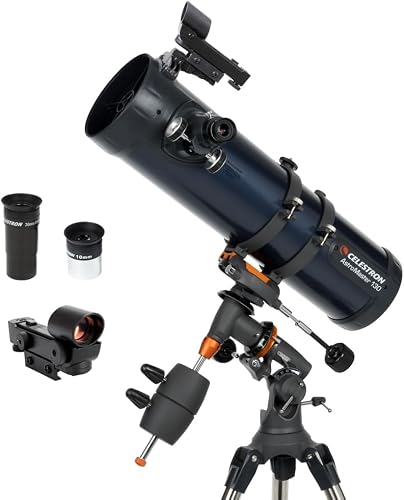
Celestron AstroMaster 130EQ Telescope
A 130mm reflector on an equatorial mount. Good light gathering for the money, with a mount that rewards a little patience and practice.
- Aperture
- 130 mm
- Design
- Newtonian reflector
- Mount
- Equatorial
What works
- Large aperture for the price
- Shows the Moon, planets and brighter deep-sky objects
- Widely sold with strong owner feedback
Watch for
- Equatorial mount takes time to learn
- Not as portable as a small refractor
Best for: a first telescope with real light-gathering power
Celestron Inspire 100AZ: easiest for families
The Inspire 100AZ is a 100mm refractor on a simple alt-azimuth tripod. You point it where you want and look, with no alignment and no counterweights. Refractors need almost no care, since there is no mirror to align, and they give crisp, high-contrast views of the Moon and planets. It also works with a phone adapter, which helps families share what they see.
It costs more than the Heritage and has less aperture, so faint objects look dimmer. The mount is light, so wobble can show up at high power. For a household where several people will use it and nobody wants to troubleshoot, that simplicity is the selling point. Parents shopping for a child might also compare it with our kids telescope guide.
Buy it if you want an easy, low-maintenance scope for the family. Skip it if you want maximum light for the money.
Easiest for families

Celestron Inspire 100AZ Refractor Telescope
A 100mm refractor on a simple point-and-look tripod. Low maintenance, sharp on the Moon and planets, and easy for a beginner to aim.
- Aperture
- 100 mm
- Design
- Refractor
- Mount
- Alt-azimuth
What works
- Simple point-and-look mount
- Good for Moon and planets
- Phone adapter makes sharing views easy
Watch for
- Smaller aperture limits faint objects
- Mount can feel light at high power
Best for: easy setup with smartphone-friendly design
Gskyer 70mm AZ Refractor: lowest-cost way to start
The Gskyer 70mm is the cheapest scope in this list, and it is here because it is widely sold and heavily rated. It is light, quick to set up and fine for the Moon and bright planets. For someone who wants to see whether stargazing sticks before spending more, it does the job.
Be realistic. A 70mm aperture gathers far less light than the other four, the mount is light and wobbles at higher power, and faint objects will be hard or invisible. Treat it as a starter that you may outgrow, and do not trust the magnification numbers on the box. If you find yourself using it often, the Heritage 150 is the natural upgrade.
Buy it if you want the lowest possible entry price. Skip it if you want views that will impress you for years.
Lowest-cost way to start
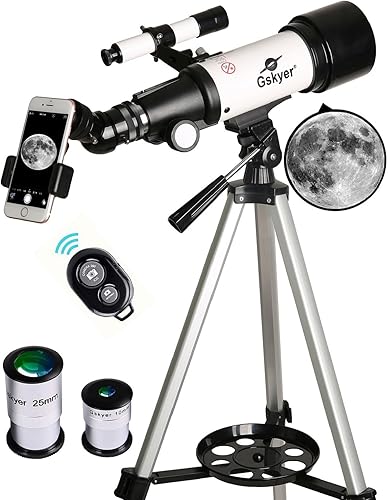
Gskyer 70mm AZ Refractor Telescope
A 70mm refractor at a very low price. It is fine for the Moon and bright planets if you keep expectations modest and handle the light mount gently.
- Aperture
- 70 mm
- Design
- Refractor
- Mount
- Alt-azimuth
What works
- Very low price
- Light and quick to set up
- Fine for the Moon and bright planets
Watch for
- Limited light-gathering
- Lightweight mount can wobble
Best for: a very low-cost starter
Side-by-side specs
| Model | Aperture | Design | Mount | Price |
|---|---|---|---|---|
| Sky-Watcher Heritage 150 Tabletop Dobsonian | 150 mm (6 inch) | Collapsible tabletop Dobsonian | Manual tabletop alt-azimuth | From about $309 |
| Celestron StarSense Explorer LT 114AZ | 114 mm (4.5 inch) | Newtonian reflector | Alt-azimuth with StarSense app | From about $240 |
| Celestron AstroMaster 130EQ Telescope | 130 mm | Newtonian reflector | Equatorial | From about $290 |
| Celestron Inspire 100AZ Refractor Telescope | 100 mm | Refractor | Alt-azimuth | From about $340 |
| Gskyer 70mm AZ Refractor Telescope | 70 mm | Refractor | Alt-azimuth | From about $97 |
Mistakes that waste a small telescope budget
Buying on magnification. A box that promises hundreds of times magnification is a warning. Real useful magnification is limited by aperture and by steady air, so look at aperture and mount quality instead.
Choosing the tallest, thinnest tripod. Thin legs shake with every touch. A short, stable mount beats a tall, flimsy one.
Ignoring where the scope will live. A scope that is hard to carry stays in the closet. Honestly think about stairs, storage and how far you will carry it. Our guide to telescopes for small spaces is useful if room is tight.
Expecting photos by eye. Galaxies and nebulae look like faint gray smudges through an eyepiece. The colorful images you see online come from long exposures. Our guide on what you can see through a telescope sets honest expectations.
Skipping the cool-down. A warm mirror in cold air makes ripples that blur the image. Leave a reflector outside for 20 to 30 minutes before you start.
What you will actually see on a small budget
The Moon is the star of any affordable telescope. Even the smallest scope here shows craters, mountain ranges and the dark plains called maria, and the view changes every night as the phase shifts. Along the edge between light and dark, the shadows make the craters look sharp and three-dimensional. It is the best first target because it is bright, easy to find and impressive immediately.
Planets come next. Jupiter shows its cloud bands and four bright moons that move from night to night. Saturn shows its rings clearly, and many first-time viewers say it looks almost too perfect to be real. Venus shows phases like a tiny Moon. Mars is a small orange disk most of the time, with more detail near its closest approach.
Deep-sky objects are more modest. Bright star clusters look good in any scope. The Orion Nebula and the Andromeda Galaxy show as soft gray glows, and a 6-inch scope shows more of them than a 70mm one. Dark skies matter more than any gear upgrade, so even a small drive away from town lights can change what you see. If you live under bright skies, see our guide to telescopes for light-polluted skies.
A simple way to choose between the five
Ask two questions. First, how will you find things: by hand, with an app, or by learning a mount? Second, where will the scope live: in a closet that suits a small tube, or in a corner where a bigger one can stay ready?
If the answers are "by hand" and "a closet", buy the Heritage 150. If you want guidance, buy the LT 114AZ. If you like learning equipment, the AstroMaster 130EQ fits. If the whole family will share it and nobody wants to troubleshoot, the Inspire 100AZ is the easy route. And if you want to test the hobby for as little as possible, the Gskyer 70mm is the starter.
Money and optics are only part of the story. A scope you use every clear night will always beat a better one that stays in a box. Pick the one that matches how you will actually behave, and your first month will go much better.
Getting the most out of a cheap telescope
A few habits improve any small telescope. Set it up in daylight first, and point it at a distant tree or building so you can line up the finder with the main view. That one step prevents most first-night frustration. Our guide on how to use a telescope covers the full routine.
Use the lowest-power eyepiece first, find the target, center it, and only then switch to more magnification. Give your eyes 20 minutes to adjust to the dark, and use a red flashlight, since white light resets that adjustment. Let the scope cool outside, and observe from a spot with the fewest streetlights in view.
For gifts, see our telescope gift guide, and for a head-to-head of two popular brands, see Celestron vs Sky-Watcher. If you want more detail on value over several years, our guide to the best telescopes for the money compares what holds up.
How we chose these telescopes
We looked at telescopes commonly sold on Amazon at lower prices and compared aperture, mount design, how objects are found and how many buyers have rated each one. We favored scopes with a long record and a large base of owner feedback, and we included a mix of styles so there is a fit for different goals.
These picks come from specifications, manufacturer information and listing research. We have not tested each telescope ourselves, and we do not claim to. Prices shown on this site are typical ranges, so check the current price on the listing before you buy. You can read how we work and how we earn money on our about page and our affiliate disclosure.
Which one should you buy?
If you want one answer, buy the Heritage 150. It puts the most light in your eye for the least money, and it has nothing to break. Choose the StarSense Explorer LT 114AZ if an app to guide you will keep you outside, the AstroMaster 130EQ if you like a traditional mount, the Inspire 100AZ if the family will share it, and the Gskyer 70mm only if the lowest price matters most. For the full picture, start at our beginner telescope list.
Frequently asked questions
What is the best affordable telescope for a beginner?
A 6-inch tabletop Dobsonian such as the Sky-Watcher Heritage 150 gives the most light for the least money. If finding objects worries you, an app-guided reflector is the next best way to spend a small budget.
How much should I spend on an affordable telescope?
A few hundred dollars is a realistic target for a scope that shows real detail. Scopes far below that can be fun for the Moon, but the mount and optics limit how much you will see. Check the current price on each listing, since it changes often.
Are cheap telescopes worth it?
Some are. A cheap scope with decent aperture and a steady mount can show craters, Saturn's rings and Jupiter's moons. A cheap scope sold on huge magnification claims usually disappoints. Judge by aperture and mount, not the number on the box.
Is a refractor or a reflector better on a small budget?
A reflector gives you more aperture per dollar, which means brighter views. A refractor needs less care and is simpler to carry, so it suits people who value convenience.
Can I take photos with an affordable telescope?
You can take phone photos of the Moon and bright planets through the eyepiece. Deep-sky photography needs a tracking mount and extra gear, which pushes it well past a small budget.
Is a telescope or binoculars better to start with on a tight budget?
Binoculars are easier and cheaper to start with, and they show the Moon, bright clusters and the Milky Way well. A small telescope shows planets and more lunar detail. If you want to see Saturn's rings, go with the telescope.
What size telescope is the minimum worth buying?
Look for an aperture of at least 70 mm for a refractor or 114 mm for a reflector. Smaller than that and you mostly pay for a tube that struggles to show more than the Moon.
What should I check before buying a cheap telescope?
Check the mount first. A wobbly mount ruins the view more than weak optics do. Also confirm it comes with at least two eyepieces and a finder, and avoid listings that brag about 400x or more.
Keep reading
Beginners, Kids and Budget Best Telescopes Under $500: Five That Are Worth Buying Five telescopes under $500, from a tabletop Dobsonian to app-guided reflectors, with honest notes on what each one shows and what you give up. 9 min read · Updated Oct 18, 2026 Best Telescopes Best Telescopes for Beginners: Five Picks That Show Real Detail Five beginner telescopes compared by aperture, mount, setup and price, with plain advice on what you will actually see and who should skip each one. 10 min read · Updated Oct 17, 2026 Best Telescopes Best Telescopes for the Money: Five Scopes With the Best Value Five telescopes ranked by what you get for the money, from a 6-inch tabletop Dobsonian to app-guided and GoTo scopes, with honest notes on the trade-offs. 8 min read · Updated Oct 29, 2026