
Celestron vs Sky-Watcher: Which Telescope Brand Fits Your Budget and Style?

If you spend any time looking at telescopes, two names keep coming up: Celestron and Sky-Watcher. Both have been making telescopes for a long time, both sell a wide range from basic starters to serious gear, and both have loyal owners. That makes the choice feel harder than it should.
The honest answer is that the two brands overlap, but each has areas where it stands out. This guide compares them on the things that matter to a buyer and picks the models in each brand worth a look. For the bigger picture, see our beginner telescope list.
Quick comparison
- 1
Sky-Watcher for the lowest cost
Sky-Watcher Heritage 150 Tabletop Dobsonian150 mm (6 inch) · Collapsible tabletop Dobsonian · Manual tabletop alt-azimuth
From about $309Check price - 2
Sky-Watcher for the most light
Sky-Watcher Flextube 200 Collapsible Dobsonian (8-inch)203 mm (8 inch) · Collapsible Dobsonian reflector · Manual alt-azimuth
From about $739Check price - 3
Celestron for guided finding
Celestron StarSense Explorer DX 130AZ Telescope130 mm · Newtonian reflector · Alt-azimuth with app guidance
From about $500Check price - 4
Celestron classic starter
Celestron AstroMaster 130EQ Telescope130 mm · Newtonian reflector · Equatorial
From about $290Check price - 5
Celestron for GoTo
Celestron NexStar 5SE Telescope125 mm · Schmidt-Cassegrain · Computerized alt-azimuth GoTo
From about $899Check price
Links go to Amazon. Prices shown are the last ones we checked and change often.
Where Sky-Watcher shines
Sky-Watcher's best-known beginner products are its Dobsonians. The Heritage and Flextube lines, with collapsible tubes, pack a lot of aperture into a small, light package. A 6-inch or 8-inch Dobsonian gives you more light than most similarly priced scopes from other brands, and the mount is simple and stable.
If your priority is the most aperture for the money, and you are happy to find objects by hand, Sky-Watcher is hard to beat. See our Dobsonian guide for the details.
Where Celestron shines
Celestron is the stronger name for guidance and computerization. The StarSense Explorer line uses a phone to help you find objects, and the NexStar line offers computerized GoTo mounts that find and track thousands of targets. Celestron also makes the classic AstroMaster reflectors that many astronomers began with, and it sells a wide range of refractors for families.
If your priority is help finding things, Celestron has more options. See telescopes that find objects for you.
How the brands compare on the basics
Aperture per dollar. Sky-Watcher Dobsonians usually lead.
Finding objects. Celestron leads with app-guided and GoTo options.
Portability. Both offer collapsible and compact designs. Sky-Watcher's collapsible Dobsonians are among the most portable large-aperture scopes.
Mount variety. Celestron offers more alt-azimuth, equatorial and computerized options at a given aperture. Sky-Watcher focuses on Dobsonians and equatorial mounts.
Support and parts. Both brands have a long record and parts for older scopes. Buying from a known seller on Amazon helps with returns.
If you are weighing these, our guide to choosing a telescope covers what to think about first.
The five picks
Sky-Watcher Heritage 150: Sky-Watcher for the lowest cost
The Heritage 150 is a 6-inch collapsible tabletop Dobsonian. It has no motors and no electronics, so there is nothing to break, and the collapsible tube stores in a closet. For its price, six inches of aperture is hard to match.
The tabletop design means you need a stable surface, and there is no tracking. If you want the most scope for the least money, it is a top choice.
Buy it if you want the best aperture for the lowest cost. Skip it if you want guided finding or tracking.
Sky-Watcher for the lowest cost
Sky-Watcher Heritage 150 Tabletop Dobsonian
A 6-inch collapsible tabletop Dobsonian. The most aperture you can get for a low price, in a simple, portable package.
- Aperture
- 150 mm (6 inch)
- Design
- Collapsible tabletop Dobsonian
- Mount
- Manual tabletop alt-azimuth
What works
- 6-inch aperture at a low price
- Collapsible and light to carry
- No assembly puzzle or alignment
Watch for
- Needs a table or stable surface
- No tracking, so you nudge it by hand
Best for: a low-cost, no-fuss first telescope
Sky-Watcher Flextube 200: Sky-Watcher for the most light
The Flextube 200 steps up to 8 inches. The collapsible tube makes it shorter for storage, and the Dobsonian mount keeps things simple. The extra aperture shows noticeably more on planets and deep-sky objects.
It costs more than the Heritage and is a larger scope to store. For many people it is the best all-round Dobsonian.
Buy it if you want strong views and have space. Skip it if you want the smallest, lowest-cost option.
Sky-Watcher for the most light

Sky-Watcher Flextube 200 Collapsible Dobsonian (8-inch)
An 8-inch collapsible Dobsonian. A step up in aperture, with the same simple mount and a collapsible tube.
- Aperture
- 203 mm (8 inch)
- Design
- Collapsible Dobsonian reflector
- Mount
- Manual alt-azimuth
What works
- Large 8-inch aperture for deep-sky and planets
- Collapsible tube is easier to store and carry
- Simple manual mount with no setup
Watch for
- Costs more than a fixed-tube 8-inch Dobsonian
- Few buyer ratings on the listing
Best for: people who want 8 inches of aperture in a storable package
Celestron StarSense Explorer DX 130AZ: Celestron for guided finding
The DX 130AZ docks your phone and uses the StarSense app to guide you to objects. It is a good fit for people who want to see targets quickly instead of learning star-hopping, and a 130mm reflector gathers enough light to make the effort worthwhile.
There is no tracking, and you need a working phone and app. If guided help keeps you outside, it is worth it.
Buy it if you want guided finding at a moderate price. Skip it if you want the most light per dollar.
Celestron for guided finding

Celestron StarSense Explorer DX 130AZ Telescope
A 130mm reflector with the StarSense phone app. The easiest way to find real targets without motors.
- Aperture
- 130 mm
- Design
- Newtonian reflector
- Mount
- Alt-azimuth with app guidance
What works
- Phone app guides you to targets
- Good light-gathering for the price
- Removes much of the star-hopping frustration
Watch for
- Needs a compatible smartphone
- Not a motorized tracker
Best for: beginners who want help finding objects
Celestron AstroMaster 130EQ: Celestron classic starter
The AstroMaster 130EQ is a 130mm reflector on an equatorial mount. More than three thousand owners have rated it. The equatorial mount lets you follow the sky with a single motion once it is aligned, and it is the type of mount many astronomers learned on.
It takes some time to learn, and the tripod is on the light side. It suits patient learners who like to figure things out.
Buy it if you want a traditional scope with a long record. Skip it if you want quick setup.
Celestron classic starter
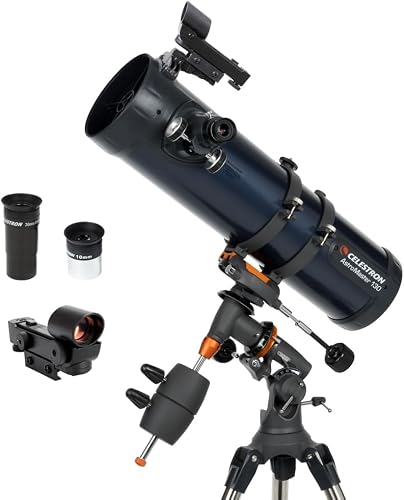
Celestron AstroMaster 130EQ Telescope
A 130mm reflector on an equatorial mount, with thousands of owner ratings. A traditional scope for patient learners.
- Aperture
- 130 mm
- Design
- Newtonian reflector
- Mount
- Equatorial
What works
- Large aperture for the price
- Shows the Moon, planets and brighter deep-sky objects
- Widely sold with strong owner feedback
Watch for
- Equatorial mount takes time to learn
- Not as portable as a small refractor
Best for: a first telescope with real light-gathering power
Celestron NexStar 5SE: Celestron for GoTo
The 5SE is a compact 5-inch scope on a computerized single-arm mount. Align it on a few stars and it finds and tracks thousands of objects. For a person who wants to show the sky to family and friends, it is a convenient tool.
It costs more than a Dobsonian with the same view and needs power. If you value the convenience, it pays off.
Buy it if you want automatic finding and tracking. Skip it if you want to save money.
Celestron for GoTo

Celestron NexStar 5SE Telescope
A compact computerized scope that finds and tracks thousands of objects. The convenient route.
- Aperture
- 125 mm
- Design
- Schmidt-Cassegrain
- Mount
- Computerized alt-azimuth GoTo
What works
- Compact and portable
- GoTo mount saves time
- Sharp views of the Moon and planets
Watch for
- Smaller aperture than the 8SE
- Higher price than basic scopes
Best for: portable GoTo with good optics
Side-by-side specs
| Model | Aperture | Design | Mount | Price |
|---|---|---|---|---|
| Sky-Watcher Heritage 150 Tabletop Dobsonian | 150 mm (6 inch) | Collapsible tabletop Dobsonian | Manual tabletop alt-azimuth | From about $309 |
| Sky-Watcher Flextube 200 Collapsible Dobsonian (8-inch) | 203 mm (8 inch) | Collapsible Dobsonian reflector | Manual alt-azimuth | From about $739 |
| Celestron StarSense Explorer DX 130AZ Telescope | 130 mm | Newtonian reflector | Alt-azimuth with app guidance | From about $500 |
| Celestron AstroMaster 130EQ Telescope | 130 mm | Newtonian reflector | Equatorial | From about $290 |
| Celestron NexStar 5SE Telescope | 125 mm | Schmidt-Cassegrain | Computerized alt-azimuth GoTo | From about $899 |
Support, warranty and what happens when something goes wrong
Both brands sell through large retailers, and both honor warranties through their dealers and distributors. In practice, the experience depends on where you buy. Purchasing from Amazon or an established astronomy retailer gives you a return window if the scope arrives damaged or with a defect. Telescopes are shipped in big boxes, and a bent mount or a loose part is a common complaint across brands, so inspect the scope when it arrives and test it on the first clear night while the return window is still open.
Parts are another matter. Celestron's popular models have a large owner base, which means accessories, replacement eyepieces and community advice are easy to find. Sky-Watcher's Dobsonians are simple, with few parts that can fail, and many owners keep the same scope for years.
What owners say, and how to read it
Owner ratings are useful, but they need context. A scope with thousands of ratings, like the AstroMaster 130EQ, has been tested by a lot of people, and the pattern of complaints is clear. A scope with fewer ratings, like the Flextube 200 or the Heritage 150, has less data, so treat the star average more carefully. Look for repeated comments about the same issue, such as a wobbly tripod or a hard-to-use finder, rather than one-off stories.
Remember too that most negative reviews on telescopes come from mismatched expectations. People expect colorful galaxies, or they try to use high power on a bad night, and they blame the scope. Our guide on what you can see through a telescope helps set expectations so that a good scope does not disappoint you.
A few things that apply to both brands
Eyepieces. The ones in the box are usable but basic. Upgrading one eyepiece later improves any scope more than switching brands. See telescope eyepieces explained.
Finders. Both brands use red-dot finders or small finder scopes on their entry models. Align yours in daylight.
Cooling. Both reflectors and compound scopes need time to match the outside air. Give them 20 to 30 minutes.
The mount. On both brands, a heavier mount usually means steadier views, which is why a Dobsonian base or a solid GoTo mount is a good sign.
Which brand for which person
You want the most aperture for the least money: Sky-Watcher Dobsonian.
You want help finding objects: Celestron StarSense or NexStar.
You want a no-maintenance family scope: Celestron's sealed refractors suit that, and our kids guide covers them.
You want portability: both offer it. A collapsible Sky-Watcher Dobsonian or a compact Celestron SE scope fit different travel styles.
You want photos: neither brand's alt-azimuth beginner scopes are made for faint-object photography. See astrophotography gear.
Do not pick on the brand alone
The brand name tells you a little, and the model tells you much more. Look at aperture, mount, how you find objects, how heavy the scope is and what owners say. A well-chosen scope from either brand beats a badly chosen one from the other.
How we chose these telescopes
We compared the best-known beginner models from both brands by aperture, mount, how objects are found, portability and owner feedback on the listings. This is research, not hands-on testing. Prices come from Amazon and are stamped with the time they were checked. Our about page and affiliate disclosure explain how we work.
Which one should you buy?
Buy a Sky-Watcher Dobsonian for the most light for the money, the Heritage 150 on a tight budget and the Flextube 200 if you can stretch. Buy a Celestron StarSense for guidance, the AstroMaster for a classic equatorial and the NexStar 5SE for GoTo.
Frequently asked questions
Is Celestron or Sky-Watcher better?
Neither wins across the board. Sky-Watcher's Dobsonians give a lot of aperture for the price. Celestron is stronger on app-guided scopes and computerized GoTo mounts.
Which brand is better for beginners?
Both make good beginner scopes. A Sky-Watcher Dobsonian is simple and powerful. A Celestron StarSense scope helps with finding objects.
Do both brands make GoTo telescopes?
Yes. Celestron's NexStar line is popular, and Sky-Watcher makes computerized mounts as well. Compare the specific models.
Are they the same quality?
Both are established brands with long records. Quality varies by model, so look at the specific scope and what owners say.
Where are the best deals?
Prices change often. Check the current price on each listing before you buy.
Which brand has better customer support?
Both have decent support. Celestron is based in the US, and Sky-Watcher sells through dealers, so support can vary by retailer. Buying from a reputable seller helps.
Are Celestron and Sky-Watcher telescopes made in the same place?
Many are made in the same Asian factories, and quality is similar at each price level. The differences are mostly in design choices and accessories.
Which brand is better for astrophotography?
Both make capable mounts. Sky-Watcher is popular for its value equatorial mounts, while Celestron offers well-known GoTo and Schmidt-Cassegrain options.
Keep reading
Best Telescopes Best Telescopes for Beginners: Five Picks That Show Real Detail Five beginner telescopes compared by aperture, mount, setup and price, with plain advice on what you will actually see and who should skip each one. 10 min read · Updated Oct 17, 2026 Types and Mounts Best Dobsonian Telescopes: Four Picks From Tabletop to 10-Inch Four Dobsonian telescopes compared by aperture, portability and price, with honest advice on which size fits your car, your storage and your sky. 8 min read · Updated Oct 20, 2026 Types and Mounts Best Telescopes That Find Objects for You: GoTo and App-Guided Computerized GoTo and phone-guided telescopes compared, with honest advice on which type of automatic finding is worth paying for and who should skip it. 8 min read · Updated Oct 21, 2026