
Best Telescopes for the Money: Five Scopes That Give You the Most for What You Spend

Value in a telescope is not the lowest price. It is the most useful thing you can see or do for the money you spend. A scope that costs less than another but shows you less is not a bargain. A scope that costs more but sits unused is a waste. The best value is the one that gets used.
This guide ranks five scopes by what they give you per dollar, and explains why. The table shows typical prices, which move, so confirm the current figure on the listing. For a wider look at the budget end, see our telescopes under $500 list.
Quick comparison
- 1
Best value overall
Sky-Watcher Heritage 150 Tabletop Dobsonian150 mm (6 inch) · Collapsible tabletop Dobsonian · Manual tabletop alt-azimuth
From about $309Check price - 2
Best value for 8 inches
Sky-Watcher Flextube 200 Collapsible Dobsonian (8-inch)203 mm (8 inch) · Collapsible Dobsonian reflector · Manual alt-azimuth
From about $739Check price - 3
Best value for guided finding
Celestron StarSense Explorer DX 130AZ Telescope130 mm · Newtonian reflector · Alt-azimuth with app guidance
From about $500Check price - 4From about $290Check price
- 5
Best value for GoTo
Celestron NexStar 5SE Telescope125 mm · Schmidt-Cassegrain · Computerized alt-azimuth GoTo
From about $899Check price
Links go to Amazon. Prices shown are the last ones we checked and change often.
What value means in a telescope
Aperture per dollar. More light means better views. This is the first measure of value, and it is why simple Dobsonians do so well.
Stability. A good mount lets you actually use the aperture. A stable scope beats a bigger wobbly one.
Convenience that you will use. Guided finding or tracking costs more, but if it keeps you outside, it is value.
Durability. A scope that lasts for years and keeps its value is worth more than one you replace in a season.
Room to grow. A scope you will not outgrow in six months saves money in the long run.
The five picks
Sky-Watcher Heritage 150: best value overall
The Heritage 150 is a 6-inch collapsible tabletop Dobsonian. No other scope in this price range gives you as much light. Six inches shows you Saturn's rings, Jupiter's cloud bands and moons, lunar detail and many brighter galaxies and clusters. The collapsible tube stores easily, and there are no electronics to fail.
The compromises are simple. It sits on a table, it has no tracking, and you need to find objects by hand. If those are acceptable, you get a lot of scope for little money.
Buy it if you want the biggest return on a small budget. Skip it if you want guided finding or tracking.
Best value overall
Sky-Watcher Heritage 150 Tabletop Dobsonian
A 6-inch collapsible Dobsonian. The most aperture per dollar here, which is the single biggest factor in what you can see.
- Aperture
- 150 mm (6 inch)
- Design
- Collapsible tabletop Dobsonian
- Mount
- Manual tabletop alt-azimuth
What works
- 6-inch aperture at a low price
- Collapsible and light to carry
- No assembly puzzle or alignment
Watch for
- Needs a table or stable surface
- No tracking, so you nudge it by hand
Best for: a low-cost, no-fuss first telescope
Sky-Watcher Flextube 200: best value for 8 inches
An 8-inch mirror gathers about 80 percent more light than a 6-inch, and the difference is visible. Planets show finer detail, and the fainter galaxies and nebulae that look marginal in a 6-inch become clear. The collapsible tube makes it much easier to store than a traditional 8-inch.
It costs more than the Heritage and takes more room. If you can afford it and store it, many observers find that 8 inches is the size they keep.
Buy it if you want a scope you will not outgrow. Skip it if you need the lowest cost or the smallest size.
Best value for 8 inches

Sky-Watcher Flextube 200 Collapsible Dobsonian (8-inch)
An 8-inch collapsible Dobsonian. Costs more than the Heritage, and delivers a clear jump in light for planets and deep-sky.
- Aperture
- 203 mm (8 inch)
- Design
- Collapsible Dobsonian reflector
- Mount
- Manual alt-azimuth
What works
- Large 8-inch aperture for deep-sky and planets
- Collapsible tube is easier to store and carry
- Simple manual mount with no setup
Watch for
- Costs more than a fixed-tube 8-inch Dobsonian
- Few buyer ratings on the listing
Best for: people who want 8 inches of aperture in a storable package
Celestron StarSense Explorer DX 130AZ: best value for guided finding
The cost of a GoTo mount is high. The StarSense approach costs much less. A phone docks on the scope, the app reads the star field and guides you to objects, and you push the scope by hand. That puts targets within reach on the first night.
The aperture is smaller than the Dobsonians, and there is no tracking. For people who would otherwise struggle to find anything, the guidance is worth the trade. See also telescopes that find objects for you.
Buy it if finding objects is your main worry. Skip it if you want the most light for the money.
Best value for guided finding

Celestron StarSense Explorer DX 130AZ Telescope
A 130mm reflector with phone-guided finding. You pay for the guidance, and it removes the hardest part of starting.
- Aperture
- 130 mm
- Design
- Newtonian reflector
- Mount
- Alt-azimuth with app guidance
What works
- Phone app guides you to targets
- Good light-gathering for the price
- Removes much of the star-hopping frustration
Watch for
- Needs a compatible smartphone
- Not a motorized tracker
Best for: beginners who want help finding objects
Celestron AstroMaster 130EQ: best proven classic
With thousands of owner ratings, the AstroMaster 130EQ is among the most reviewed beginner scopes on Amazon. A 130mm reflector on an equatorial mount gives a good view for the price, and the mount lets you follow objects with a single motion once you have learned it.
It takes effort to learn, and the tripod is light. If you like figuring out how things work, it is a rewarding scope with a long record.
Buy it if you want a traditional scope with deep owner feedback. Skip it if you want quick, simple setup.
Best proven classic
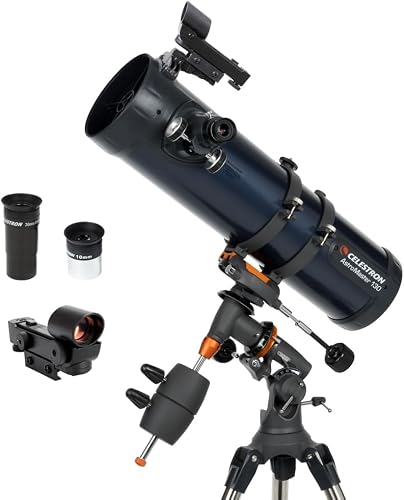
Celestron AstroMaster 130EQ Telescope
A 130mm reflector on an equatorial mount with thousands of ratings. A time-tested choice for patient learners.
- Aperture
- 130 mm
- Design
- Newtonian reflector
- Mount
- Equatorial
What works
- Large aperture for the price
- Shows the Moon, planets and brighter deep-sky objects
- Widely sold with strong owner feedback
Watch for
- Equatorial mount takes time to learn
- Not as portable as a small refractor
Best for: a first telescope with real light-gathering power
Celestron NexStar 5SE: best value for GoTo
The 5SE is not cheap, but among computerized scopes from known brands it is one of the lowest-cost ways to get a real GoTo mount. After alignment, it finds and tracks thousands of objects, and the compact design is easy to move.
It costs more than a Dobsonian with similar aperture, since you pay for the mount. If automatic finding and tracking are what you want, it is good value for the feature.
Buy it if you want GoTo at a sensible price. Skip it if you want the most light per dollar.
Best value for GoTo

Celestron NexStar 5SE Telescope
A compact computerized scope that finds and tracks objects. It costs more, and it is one of the lowest-cost routes to real GoTo.
- Aperture
- 125 mm
- Design
- Schmidt-Cassegrain
- Mount
- Computerized alt-azimuth GoTo
What works
- Compact and portable
- GoTo mount saves time
- Sharp views of the Moon and planets
Watch for
- Smaller aperture than the 8SE
- Higher price than basic scopes
Best for: portable GoTo with good optics
Side-by-side specs
| Model | Aperture | Design | Mount | Price |
|---|---|---|---|---|
| Sky-Watcher Heritage 150 Tabletop Dobsonian | 150 mm (6 inch) | Collapsible tabletop Dobsonian | Manual tabletop alt-azimuth | From about $309 |
| Sky-Watcher Flextube 200 Collapsible Dobsonian (8-inch) | 203 mm (8 inch) | Collapsible Dobsonian reflector | Manual alt-azimuth | From about $739 |
| Celestron StarSense Explorer DX 130AZ Telescope | 130 mm | Newtonian reflector | Alt-azimuth with app guidance | From about $500 |
| Celestron AstroMaster 130EQ Telescope | 130 mm | Newtonian reflector | Equatorial | From about $290 |
| Celestron NexStar 5SE Telescope | 125 mm | Schmidt-Cassegrain | Computerized alt-azimuth GoTo | From about $899 |
A closer look at aperture per dollar
It helps to put numbers on it. Light gathering scales with the area of the mirror, so doubling the diameter quadruples the light. A 6-inch mirror collects about 28 square inches of light, and an 8-inch collects about 50. That is a big gain for a modest increase in size, which is why the jump from 6 to 8 inches is the one most owners say they notice. Going from 8 to 10 inches adds another 56 percent, and from 10 to 12 inches another 44 percent. The gains are real, and the price, weight and storage needs grow faster than the gains.
Small refractors and compact computerized scopes cost much more per inch of aperture, which is why they score lower on pure value. They make up for it in other ways: sealed tubes, tracking, portability. That is the trade you are making when you pay more per inch.
What holds its value
If you might sell later, simple scopes hold their value best. A Dobsonian from a known brand sells easily in local astronomy groups, because buyers know what they are getting and there is little that can go wrong. Computerized scopes sell too, but the electronics add a risk that buyers price in. Scopes with unusual or very cheap designs are the hardest to resell.
Buying a scope from a known brand with a long record also means accessories, eyepieces and advice are easy to find, and that adds to its long-term value.
Value over five years
Think about what you will own in a few years. A good Dobsonian is likely to be in service for a decade or more, since there is little to wear out. You may add a better eyepiece, a finder or a collimation tool along the way, and the scope stays useful. A scope that you outgrow in a season has cost you the price twice, once to buy and once to replace.
That is why a slightly larger first scope is often better value than a slightly cheaper one. If your budget allows, step up to the aperture you will want once you are hooked, so that you are not shopping again soon. If you are unsure how much to spend, our telescopes under $500 and under $1,000 guides lay out what each budget gets you.
Where money is wasted
Accessory bundles. A long list of extra eyepieces and filters rarely makes up for a small mirror or a flimsy mount.
Magnification claims. A big number on the box tells you nothing about image quality.
Buying too small. A scope you outgrow in a few months costs you twice.
Buying too big. A scope too heavy to carry will not get used.
Ignoring the mount. A weak mount makes any tube frustrating.
When it pays to spend more
Spending more makes sense when it buys a feature you will use. If you know you will give up on finding objects by hand, guidance or GoTo is worth it. If you plan to take photos, spending on a tracking mount matters. If you have a dark site and room, more aperture pays off. Our guide to choosing a telescope helps match the spending to your goals.
When to spend less
Spending less makes sense when you are unsure the hobby will stick. A low-cost Dobsonian shows a lot and holds its value if you decide to sell. A child's first scope can start modest, and our kids guide covers options.
How we chose these telescopes
We compared aperture, mount, how objects are found and owner feedback on the listings, and we weighed those against typical price ranges. This is research, not hands-on testing. Prices come from Amazon and are stamped with the time they were checked. Our about page and affiliate disclosure explain how we work.
Shopping at the low end of the range? See our picks for the best affordable telescopes.
Which one should you buy?
For the most value, buy the Heritage 150. If you can stretch, buy the Flextube 200. If guidance is what you need, buy the StarSense DX 130AZ. For a classic, the AstroMaster 130EQ. For GoTo, the NexStar 5SE.
Frequently asked questions
What is the best value telescope?
For most buyers, a Dobsonian. It puts the money into the mirror, so you get the most aperture and the best views for the price.
Is it worth spending more on a telescope?
Up to a point. More money buys more aperture or convenience such as guidance and tracking. Beyond that, you pay for features you may not use.
How do I avoid overpaying?
Judge a scope by aperture and mount, not by magnification claims or the number of accessories in the box.
Are cheap telescopes ever good?
Some are fine. The risk is at the very bottom, where shaky mounts and weak optics are common.
Should I wait for a sale?
Prices on Amazon move, so check the current price. If the price is close to its usual level, waiting rarely pays off.
What is the best value telescope for beginners?
A 6-inch or 8-inch Dobsonian is generally the best value because it gives the most aperture for the money. A GoTo scope costs more for the same size.
Do accessories matter as much as the telescope?
A good eyepiece or a steady mount can improve the view more than a small upgrade in the telescope itself. Spend on the mount before extras.
When is the best time to buy a telescope?
Holiday sales and seasonal deals often cut prices. Check the price history on Amazon, and do not wait forever, since seeing the sky is the whole point.
Keep reading
Best Telescopes Best Telescopes for Beginners: Five Picks That Show Real Detail Five beginner telescopes compared by aperture, mount, setup and price, with plain advice on what you will actually see and who should skip each one. 10 min read · Updated Oct 17, 2026 Beginners, Kids and Budget Best Telescopes Under $500: Five That Are Worth Buying Five telescopes under $500, from a tabletop Dobsonian to app-guided reflectors, with honest notes on what each one shows and what you give up. 9 min read · Updated Oct 18, 2026 Best Telescopes Best Telescopes Under $1,000: Five Upgrades Worth the Money Five telescopes under $1,000, from 8-inch Dobsonians to computerized GoTo and app-guided scopes, with honest advice on what the extra money really buys. 7 min read · Updated Oct 31, 2026