Best Telescopes for Apartments and Small Spaces: Four Picks That Fit Your Life

An apartment is not the obvious home for a telescope. You may have a small balcony, a view of a few streetlights and a closet that is already full. The good news is that a small telescope fits a small home well, and the best targets in the sky, the Moon and the planets, are bright enough to enjoy from almost anywhere.
This guide covers four telescopes that suit small spaces, and explains how to get a good view from a balcony or a shared yard. For other ideas, see our portable telescopes guide.
Quick comparison
- 1
Best for most apartments
Sky-Watcher Heritage 150 Tabletop Dobsonian150 mm (6 inch) · Collapsible tabletop Dobsonian · Manual tabletop alt-azimuth
From about $309Check price - 2From about $340Check price
- 3
Best with app help
Celestron StarSense Explorer 150mm Tabletop Dobsonian150 mm (6 inch) · Tabletop Dobsonian · Manual tabletop with StarSense app
From about $510Check price - 4From about $97Check price
Links go to Amazon. Prices shown are the last ones we checked and change often.
What matters in a small space
Storage size. A collapsible tube or a small refractor fits in a closet. A long-tube scope does not.
Setup time. If it takes ten minutes to get ready, you will skip many nights. A scope that sets up in a minute gets used.
Weight. You may carry the scope up and down stairs or across a parking lot.
A clear view. A balcony facing the right way matters more than the scope. South-facing views in the northern hemisphere show the most sky.
Stability. Floors and railings vibrate. A scope needs a steady place to sit.
Observing from a balcony
Balconies bring a few challenges. The building behind you radiates heat, which can create rising warm air and blur the view. Railings and floors can shake when you walk. The view is limited by walls and neighbors.
A few habits help. Set up away from the wall, as far out as you safely can. Wait for the scope to cool. Keep your movements slow, since a vibrating floor can shake the image. Pick targets that are in the clear part of your sky. Use an app to see what is up and where.
Do not observe through a window. The glass distorts the image, and the warm air from inside makes ripples. Even a small scope looks far better outside. For tips on your first night, see how to use a telescope.
The four picks
Sky-Watcher Heritage 150: best for most apartments
The Heritage 150 is a collapsible 6-inch tabletop Dobsonian. With the tube collapsed, it is compact and easy to store in a closet. It sets up in a minute, and the 6-inch mirror shows planets, the Moon and many star clusters well. It sits on a table, which suits a balcony with a sturdy table.
There is no tracking, so you nudge it by hand. For a small home, it is a great balance of storage and views.
Buy it if you want the most scope in the least space. Skip it if you have no stable surface for a tabletop scope.
Best for most apartments
Sky-Watcher Heritage 150 Tabletop Dobsonian
A 6-inch collapsible tabletop Dobsonian. It stores small and sets up in a minute, with real aperture.
- Aperture
- 150 mm (6 inch)
- Design
- Collapsible tabletop Dobsonian
- Mount
- Manual tabletop alt-azimuth
What works
- 6-inch aperture at a low price
- Collapsible and light to carry
- No assembly puzzle or alignment
Watch for
- Needs a table or stable surface
- No tracking, so you nudge it by hand
Best for: a low-cost, no-fuss first telescope
Celestron Inspire 100AZ: easiest to live with
The Inspire 100AZ is a 100mm refractor with a sealed tube and a simple tripod. It has no mirrors to align and almost no maintenance, which suits a person who wants to grab a scope and go. It is tough and handles bumps in a closet.
The aperture is modest, so faint objects are limited, but the Moon and planets are crisp.
Buy it if you want a low-effort scope. Skip it if you want deep-sky views.
Easiest to live with

Celestron Inspire 100AZ Refractor Telescope
A 100mm refractor with a sealed tube and a simple tripod. Quick to set up and low maintenance.
- Aperture
- 100 mm
- Design
- Refractor
- Mount
- Alt-azimuth
What works
- Simple point-and-look mount
- Good for Moon and planets
- Phone adapter makes sharing views easy
Watch for
- Smaller aperture limits faint objects
- Mount can feel light at high power
Best for: easy setup with smartphone-friendly design
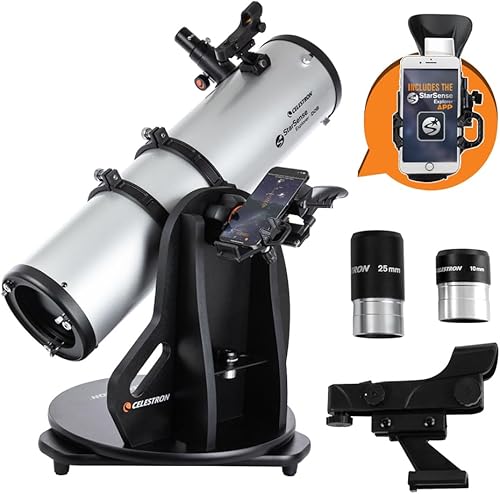
Celestron StarSense Explorer 150mm Tabletop: best with app help
In an apartment, you often cannot see many stars, which makes finding objects harder. The StarSense app uses the phone camera to read the stars it can see and guides you to targets. This 150mm tabletop Dobsonian is compact and simple, and it adds that guidance.
It costs more than the unguided Heritage, and it needs a phone. For a bright sky, the guidance is useful. See telescopes that find objects for you.
Buy it if you want guided finding in a compact scope. Skip it if you want to spend less.
Best with app help
Celestron StarSense Explorer 150mm Tabletop Dobsonian
A 150mm tabletop Dobsonian with phone-guided finding. Light, compact and helpful when you cannot see many stars.
- Aperture
- 150 mm (6 inch)
- Design
- Tabletop Dobsonian
- Mount
- Manual tabletop with StarSense app
What works
- 6-inch aperture at a mid-range price
- Phone app helps you find targets
- Compact and easy to carry
Watch for
- Needs a table or sturdy surface
- No tracking
Best for: an app-guided scope you can carry
Gskyer 70mm AZ Refractor: smallest and lowest cost
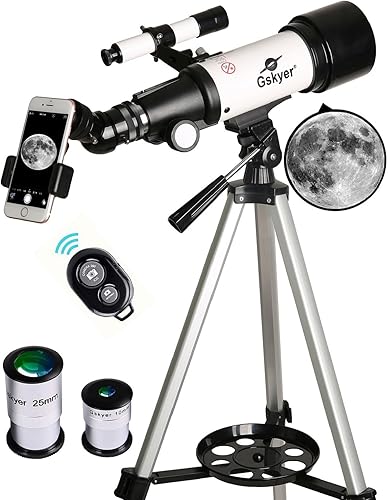
The Gskyer 70mm is a small, light refractor that takes little room. It is quick to set up and easy to carry. The listing has a very large base of buyer ratings and includes extras such as a phone adapter.
The small aperture shows less detail, and the mount is light. It is fine for the Moon and planets, and it is an easy way to try astronomy in a small home.
Buy it if space and cost matter most. Skip it if you want detail.
Smallest and lowest cost
Gskyer 70mm AZ Refractor Telescope
A 70mm refractor that is light and takes little room. Small aperture, with a very large base of buyers.
- Aperture
- 70 mm
- Design
- Refractor
- Mount
- Alt-azimuth
What works
- Very low price
- Light and quick to set up
- Fine for the Moon and bright planets
Watch for
- Limited light-gathering
- Lightweight mount can wobble
Best for: a very low-cost starter
Side-by-side specs
| Model | Aperture | Design | Mount | Price |
|---|---|---|---|---|
| Sky-Watcher Heritage 150 Tabletop Dobsonian | 150 mm (6 inch) | Collapsible tabletop Dobsonian | Manual tabletop alt-azimuth | From about $309 |
| Celestron Inspire 100AZ Refractor Telescope | 100 mm | Refractor | Alt-azimuth | From about $340 |
| Celestron StarSense Explorer 150mm Tabletop Dobsonian | 150 mm (6 inch) | Tabletop Dobsonian | Manual tabletop with StarSense app | From about $510 |
| Gskyer 70mm AZ Refractor Telescope | 70 mm | Refractor | Alt-azimuth | From about $97 |
What you can see from an apartment
The Moon, planets, bright double stars and a few bright star clusters are all within reach from a typical apartment. Jupiter and Saturn look just as good from a balcony as from a dark site. Fainter galaxies and nebulae are harder, and you may need to drive to a darker place. Our guide on light-polluted skies covers what works from the city.
Storage and care
Keep the scope covered, in a closet or a corner, away from heat sources. Store the eyepieces in a small case. If you have a reflector, check the alignment now and then. Our collimation guide walks through it. Before you observe, put the scope outside for 20 to 30 minutes so that it matches the air.
Being a good neighbor
If you observe from a shared balcony or a courtyard, keep lights low. Use a red flashlight, and avoid shining lights at neighbors' windows. Many people enjoy a look through a telescope, so you may make friends.
A closer look at balcony physics
Heat is the enemy of a balcony observer. During the day, the building's walls and the balcony floor soak up the sun, and at night they release that heat as rising air. That warm air crosses the telescope's field of view and blurs the image, especially for planets at high power. The effect is worst in the first hours after sunset and eases as the building cools.
You can reduce it. Set up as far from the wall as is safe, and keep the scope away from the railing's solid base. If your balcony has a metal rail, avoid looking over it, since metal holds heat. Observing later in the night often gives steadier views. If the air still looks wobbly, drop to lower power and concentrate on wider targets.
Using the sky you have
An apartment balcony rarely gives a full view. A narrow strip of sky is still enough to show a lot, if you plan for it. Use a planetarium app to see what passes through your window of sky and when. Planets move through the south and the ecliptic, so a view toward the south in the northern hemisphere shows the most. The Moon travels the same path.
If the view to the east or west is blocked, wait until objects climb into your clear zone. For a view that is blocked to the south, consider a nearby park, a rooftop with permission or a short drive on clear nights. A portable scope makes that easy, and our portable telescopes guide covers the best options.
Keeping the scope ready
The best apartment telescope is the one that is easy to reach. Keep it in a closet near the door, with the eyepieces in a small case beside it, so that you can set up in two minutes. A scope that is buried behind boxes will not get used. If you have a tabletop scope, keep a sturdy small table nearby, so that you do not have to find a surface each time.
If you observe from a shared space, keep lights low and respect your neighbors. A red flashlight keeps your night vision and annoys nobody.
For the best value across every type, see best telescopes for the money.
How we chose these telescopes
We compared storage size, setup time, weight, aperture and owner feedback on the listings. This is research, not hands-on testing. Prices come from Amazon and are stamped with the time they were checked. Our about page and affiliate disclosure explain how we work.
Which one should you buy?
For most apartments, buy the Heritage 150. For the easiest scope, buy the Inspire 100AZ. For guidance, choose the StarSense 150mm Tabletop. For the smallest and lowest cost, the Gskyer 70mm. For the wider range, see our beginner telescope list.
Frequently asked questions
Can I use a telescope on a balcony?
Yes, if you have a clear view and a stable floor. Avoid setting up close to a wall or over a heated roof, which creates blurring air.
Can I use a telescope through a window?
Not well. Glass distorts the image, and warm air from the room causes ripples. Observe from outside.
What size telescope is best for an apartment?
A collapsible 6-inch Dobsonian or a small refractor. They store easily and still show a lot.
How do I handle light pollution from an apartment?
Aim at the Moon, planets and double stars, which are not affected much. Take the scope to a darker site for faint objects.
Where do I store a telescope?
A closet or the corner of a room works. Keep it covered, and let it reach outdoor temperature before use.
Can I use a telescope through an open window?
Yes if the window is open and the room is cool, but warm air flowing out distorts the view. A balcony or a nearby park is much better.
What telescope works best for city balconies?
A small refractor or a compact tabletop scope on a steady table. Aim for the Moon and planets, which show well even in bright skies.
Can I use a telescope indoors?
Not usefully. Window glass and warm air degrade the image badly. Take the telescope outside to see sharp detail.
Keep reading
Types and Mounts Best Portable Telescopes: Five Scopes You Can Actually Carry Five portable telescopes for travel, camping and small cars, compared by weight, setup time and what you can see, with honest notes on the trade-offs. 8 min read · Updated Oct 30, 2026  Planets, Galaxies and Photos Best Telescopes for Light-Polluted Skies: Four Picks for City Viewing Four telescopes that work well under city and suburban skies, with honest advice on what you can see from a bright backyard and how to get more. 8 min read · Updated Nov 5, 2026 Best Telescopes Best Telescopes for Beginners: Five Picks That Show Real Detail Five beginner telescopes compared by aperture, mount, setup and price, with plain advice on what you will actually see and who should skip each one. 10 min read · Updated Oct 17, 2026