Refractor vs Reflector Telescopes: Which Type Should You Buy?

Telescope shopping soon runs into three words: refractor, reflector and catadioptric. They describe how a telescope gathers and focuses light, and they shape how it feels to own. This guide explains each in plain language and tells you which suits which person.
If you only remember one thing, remember this: a reflector gives you more light per dollar, a refractor gives you less fuss, and a compact catadioptric gives you a long focal length in a small package. For broader buying advice, see our guide to choosing a telescope.
Refractors: a lens at the front
A refractor uses a lens at the front of a sealed tube to bend light to a focus at the back. You look through an eyepiece at the rear. It is the classic telescope shape that most people picture.
Strengths. The sealed tube keeps dust out and holds its optics steady, so it needs almost no maintenance. Views are crisp and high in contrast, which suits the Moon and planets. They cool quickly, handle bumps well and tend to be easy to use.
Weaknesses. Lenses are expensive to make, so for a given price, a refractor has less aperture than a reflector. Cheaper refractors can show color fringes around bright objects, called chromatic aberration. Larger refractors are long and heavy.
Best for. Families, kids, anyone who wants low maintenance and sharp views of the Moon and planets. See telescopes for kids for examples.

Reflectors: a mirror at the back
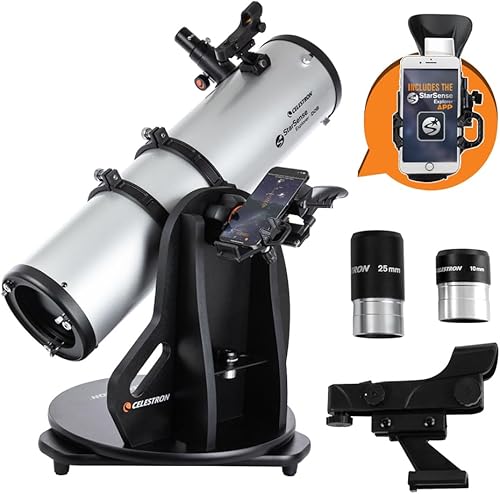
A reflector uses a curved mirror at the back of the tube to gather light and bounce it to a smaller mirror and the eyepiece. The most common beginner version is the Newtonian, and it is the design inside a Dobsonian.
Strengths. Mirrors are cheaper than lenses, so you get much more aperture for the price. That means brighter, more detailed views and the ability to see faint galaxies and nebulae. There is no color fringing.
Weaknesses. The tube is open, so dust can settle and the mirror needs to cool before use. The mirrors need occasional alignment, called collimation. A large reflector is a bulky scope.
Best for. Anyone who wants the most light for the money. See our Dobsonian guide for the best examples, and learn the alignment in how to collimate a Newtonian telescope.
Catadioptrics: lenses and mirrors together
A catadioptric telescope, such as the Schmidt-Cassegrain or Maksutov-Cassegrain, uses both a corrector lens at the front and mirrors inside. The light bounces back and forth in the tube, which gives a long focal length in a short, compact body.
Strengths. Compact and portable for the aperture. A long focal length suits planets and the Moon, and the sealed design keeps dust out. They pair well with computerized mounts. The NexStar SE line uses this design, and you can see examples in telescopes that find objects for you.
Weaknesses. More expensive per inch of aperture than a Dobsonian. They need time to cool. The long focal length means a narrow field of view, which is less suited to wide star fields.
Best for. People who want a compact, tracking scope for planets and a mix of objects.

Side by side
| Feature | Refractor | Reflector | Catadioptric |
|---|---|---|---|
| Cost per inch of aperture | Highest | Lowest | Middle |
| Maintenance | Very low | Occasional collimation | Low |
| Portability | Good in small sizes | Bulky, unless collapsible | Very compact |
| Best targets | Moon, planets | Everything, especially deep-sky | Planets, mixed |
| Cooling time | Fast | Moderate | Slow |
How the optics actually work
The easiest way to hold the three designs in your head is to follow the light. In a refractor, light enters through the lens, bends as it passes through the glass and focuses at the back of the tube, where you put your eye. In a reflector, light travels down the open tube, hits the main mirror at the bottom, bounces back up to a small flat mirror near the front and gets directed sideways into the eyepiece. In a catadioptric, light passes through a thin corrector plate, hits the main mirror, bounces forward to a small secondary mirror and back through a hole in the main mirror to the eyepiece at the rear.
That folding is why catadioptrics are so compact. A 5-inch Schmidt-Cassegrain has a focal length that would need a very long tube in a refractor, and the folded path puts it in a short one.
Focal length, focal ratio and why they matter
You will see two numbers on many listings: focal length in millimeters and focal ratio, written like f/5 or f/10. Focal length is the distance from the main lens or mirror to the focus. Focal ratio is the focal length divided by the aperture.
A low focal ratio, like f/5, gives a wide field of view and a bright image at a given power, which suits star clusters, large nebulae and the Milky Way. A high focal ratio, like f/10, gives a narrower field and higher magnification for a given eyepiece, which suits planets and the Moon. That is why a compound scope with a long focal length is a favorite for planets, and a fast Dobsonian is a favorite for wide-field deep-sky views.
You do not need to memorize this. It helps to know that a "fast" scope shows more sky at once, and a "slow" scope magnifies more. Each has a place, and many observers own both kinds eventually.
Color fringing and other optical quirks
Simple refractor lenses can bend different colors by slightly different amounts, so bright objects may show a purple or blue halo. Better refractors use special glass or extra lens elements to reduce that, and they cost more. In a budget refractor, you may see the halo around the Moon or Jupiter. It does not ruin the view, but it is worth knowing.
Reflectors do not have this issue, since mirrors reflect all colors equally. They have their own quirk: the small secondary mirror blocks a little light and leaves a faint shadow, which slightly reduces contrast on planets compared with an unobstructed refractor. The effect is small for most users.

What to do next
If you have decided on a type, the next step is choosing a specific model. For reflectors, start with the Dobsonian guide. For refractors, our kids guide covers easy, sealed designs. For compact catadioptrics with tracking, see telescopes that find objects for you.
How aperture changes the answer
Aperture is the biggest factor in what you see. A 100mm refractor and a 130mm reflector at similar prices differ in light gathering by about 70 percent, which is why reflectors win on faint objects. Where a refractor shines is in simplicity and in contrast on bright targets.
If you plan to look at planets and the Moon, the difference between the types is small, and the best choice is the one you will use often. If you want galaxies and nebulae, a reflector wins. See telescopes for planets for how each type performs on planets.
Maintenance, in plain terms
Refractors: wipe the lens only when it is dirty, and otherwise leave it alone. That is nearly all there is.
Reflectors: let the mirror cool for 20 to 30 minutes, keep the cover on and check collimation now and then. Collimation takes a few minutes with a simple tool.
Catadioptrics: let them cool, keep the corrector clean and avoid dew with a shield. Collimation is rarely needed.
Which one for which person
- You want the most views for the least money: reflector, such as a Dobsonian.
- You want a worry-free scope for the family: small refractor.
- You want a compact, tracking scope: catadioptric on a computerized mount.
- You want to see faint objects: the biggest reflector you can carry.
- You want photos of the Moon and planets: a catadioptric or refractor on a tracking mount. See astrophotography gear.
Common myths
"Refractors are always sharper." A good reflector can match a refractor in sharpness. The difference is mostly contrast on bright targets.
"Reflectors need constant fiddling." Most stay aligned for a long time, and alignment takes minutes.
"More magnification means a better telescope." Not true. Aperture and steadiness decide how much you can use.
A practical example
Imagine two friends with a similar budget. One buys a 100mm refractor on a simple tripod. The other buys a 6-inch collapsible Dobsonian. On the first night, the refractor owner is observing in two minutes, and the Dobsonian owner is ready in three. Both look at the Moon, and both are thrilled. A few weeks later, both look at Saturn, and the Dobsonian owner sees the rings with more detail. Then they look at the Orion Nebula, and the Dobsonian owner sees much more of its wings.
A year later, the refractor owner still has a scope that needs nothing, and the Dobsonian owner has had to collimate it twice. Both are happy. They bought different tools for different priorities, and both bought well. That is the real answer: choose the type that matches how you will use the scope.
How we research
We compare designs by aperture, cost, maintenance and use, drawing on manufacturer information and owner feedback. This is research, not hands-on testing. See our about page and affiliate disclosure for how we work. If you are ready to shop, start with our beginner telescope list.
Frequently asked questions
Is a refractor or reflector better for beginners?
A reflector, especially a Dobsonian, gives more aperture for the money. A refractor is easier to care for. Both are good, and the choice depends on budget and maintenance tolerance.
Which is better for planets?
A refractor gives crisp, high-contrast views, but a larger reflector shows more detail overall. Aperture usually wins.
Do reflectors need a lot of maintenance?
Little. They need an occasional alignment called collimation, and a mirror that cools before use.
What is a catadioptric telescope?
A design that uses both lenses and mirrors, like the Schmidt-Cassegrain. It folds a long light path into a short tube.
Which type is more portable?
Small refractors and compact catadioptrics are very portable. Large Dobsonian reflectors are bulky unless they collapse.
Which type gives better value for the money?
Reflectors give far more aperture per dollar, so they win on value. Refractors are simpler and need less upkeep but cost more for the same size.
Is a Schmidt-Cassegrain a refractor or reflector?
Neither exactly. It is a catadioptric telescope that uses both a lens and mirrors in a compact tube, and it works well for planets and portability.
Do refractors have color fringing?
Cheaper achromatic refractors can show color fringes around bright objects. Apochromatic models reduce it but cost more.
Keep reading
 Best Telescopes How to Choose a Telescope: What Matters and What Does Not A plain guide to choosing a telescope: aperture, mount, type, how you find objects, and the claims on the box that you can safely ignore. 8 min read · Updated Oct 22, 2026 Types and Mounts Best Dobsonian Telescopes: Four Picks From Tabletop to 10-Inch Four Dobsonian telescopes compared by aperture, portability and price, with honest advice on which size fits your car, your storage and your sky. 8 min read · Updated Oct 20, 2026
 Planets, Galaxies and Photos Best Telescopes for Planets: Five Scopes for Sharp Views Five telescopes for viewing Jupiter, Saturn, Mars and the Moon, compared by aperture, optics and ease of use, with honest notes on what each will show. 8 min read · Updated Oct 23, 2026