
Telescope Mounts Explained: Which Mount Should You Choose?
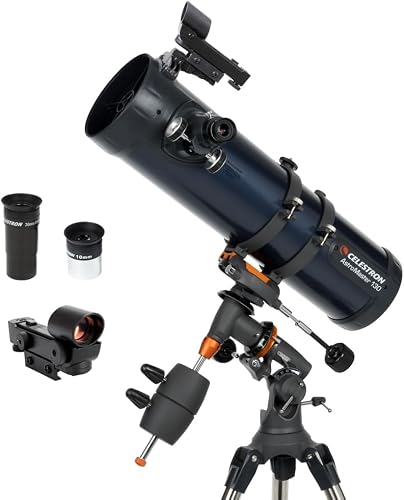
Most people shop for a telescope by looking at the tube. The part that decides whether you enjoy it is the mount. A great mirror on a wobbly, confusing mount ends up in a closet, while a modest tube on a steady, simple mount gets used every clear night. That is why mount questions, especially about the equatorial mount, come up so often.
This guide explains the four main designs in plain language: alt-azimuth, equatorial, Dobsonian and GoTo. You will see what each one does, what it asks of you and who it suits. If you are still choosing the telescope itself, start with our guide to choosing a telescope and come back here to settle the mount.
What a mount actually has to do
A mount has two jobs. It has to hold the tube steady enough that the image stops shaking within a second or two of touching the focuser. And it has to let you aim at a target and keep it there as the sky turns overhead.
The second job is the tricky one. The Earth rotates, so every object drifts out of the eyepiece. At low power you barely notice. At the high power you use on Saturn or the Moon, a target can leave the view in under a minute. Each mount design solves that drift differently, and that is the real difference between them.
Alt-azimuth mounts: simple and intuitive
An alt-azimuth mount, often shortened to alt-az, moves in two directions: up and down (altitude) and left and right (azimuth). It works like a camera tripod head. You point at something, look through the eyepiece and nudge the tube as the object drifts.
The big advantage is that there is nothing to learn. You set it down, aim and look. Most small refractors and many starter reflectors use this design, including app-guided models such as the Celestron StarSense Explorer DX 130AZ. The trade-off is that you follow targets by hand with small pushes in two directions, and a fixed alt-az mount cannot support long photographic exposures.

Best for: first-time observers, kids, anyone who wants grab-and-go simplicity and mostly looks at the Moon, planets and bright objects.
Dobsonian mounts: the best value in astronomy
A Dobsonian is an alt-az design built as a rocker box. The tube sits on smooth bearings and swings freely in both directions, held by friction. There is no tripod to level, no motor and no alignment. It is stable, quick and cheap to build, so the money goes into the mirror instead of into hardware.
That is why a Dobsonian gives you the most aperture per dollar. A tabletop model like the Sky-Watcher Heritage 150 gives you a 6-inch mirror that collapses for carrying, and larger floor-standing models go much bigger. We cover the full range in our best Dobsonian telescopes list. The limits are that you push by hand, it cannot track for photos, and larger Dobsonians are big enough that you need storage space and a car to move them.

Best for: people who want the best views for the least money and enjoy learning the sky by hand.
Equatorial mounts: built to follow the sky
An equatorial mount tilts one axis to point at the celestial pole, the spot in the sky that appears fixed while everything else rotates around it. In the Northern Hemisphere that spot is close to Polaris. Once that axis is aligned, turning only that one axis follows the sky. You turn a single slow-motion knob, or let a motor do it, and the target stays in view.
That makes an equatorial mount the right tool for tracking and the only real option for long-exposure photography. It is also why it feels strange at first. The tube moves in directions that do not match up and down or left and right, and you have to set up the polar axis before the mount does its job. Many beginners find that the first few nights are a little confusing. Our how to use a telescope guide walks through the first-night routine.
An entry-level example is the Celestron AstroMaster 130EQ, a 130mm reflector on an equatorial mount. It shows the Moon, planets and brighter deep-sky objects well for the aperture. The mount is the part that takes learning, and a lightweight equatorial can shake more than a Dobsonian at high power, so be gentle and let it settle after each adjustment.
Best for: people who want to follow objects smoothly, plan to try photography later or do not mind a learning curve.
Do you need to polar align for visual use?
Not precisely. For looking, a rough alignment is enough. Set the latitude scale to your location, point the polar axis roughly at Polaris and use the slow-motion knob to follow objects. Photography is a different story, where fine alignment decides whether stars stay round over a long exposure. Our astrophotography picks cover the gear that goes with it.
GoTo mounts: the telescope does the finding
A GoTo mount adds motors and a computer to an alt-az or equatorial design. You enter your location, align on a few bright stars, and the mount can then point at thousands of objects and track them as they move. If finding faint objects is the part you dread, a GoTo mount removes it.
An example is the Celestron NexStar 8SE, a computerized alt-az mount carrying an 8-inch Schmidt-Cassegrain tube. It finds and tracks targets so you spend the night looking instead of searching. The cost is price, power (you need a battery or supply) and a few minutes of alignment at the start. Our GoTo guide compares the other options.

A GoTo mount on an alt-az base still has a limit for photography. The tube rotates in the frame over a long exposure, so serious deep-sky imaging usually needs a computerized equatorial mount instead.
Best for: people who want to see many objects in one night and would rather not hunt for them.
Star trackers: a mount for a camera, not a telescope
A star tracker is a small equatorial mount built to carry a camera and a lens, not a telescope. It turns at the sky's rate so you can take much longer exposures of the Milky Way and wide star fields. Models such as the Sky-Watcher Star Adventurer 2i Pro Pack and the iOptron SkyGuider Pro are popular, and the usual payload is a camera with a modest lens.
If your goal is wide photos, a tracker is often a cheaper and easier start than a telescope on an equatorial mount. We explain why in star tracker vs telescope.

Quick comparison of mount types
| Mount | Ease of use | Tracks the sky | Photo use | Cost for the aperture |
|---|---|---|---|---|
| Alt-azimuth | Very easy | By hand | Moon and planets only | Moderate |
| Dobsonian | Very easy | By hand | Poor | Lowest |
| Equatorial | Takes practice | Yes, one axis | Good with a motor | Moderate |
| GoTo alt-az | Easy after alignment | Yes, motorized | Limited | Higher |
| Star tracker | Takes practice | Yes | Wide-field only | Camera gear only |
Stability and payload: the details that matter
Two numbers decide whether a mount suits a telescope. The first is payload, the weight the mount is rated to carry. Choose a mount rated for around twice the weight of the tube plus eyepieces, camera and any finder. A mount at its limit shakes and tracks badly.
The second is the tripod. Steel or thick-legged tripods damp vibration far better than thin aluminum ones. Short legs help too, since a lower tripod is steadier, though you may need a stool. A good test is to tap the tube while looking through it at high power. If the image keeps shaking for more than two or three seconds, the mount is too light for that telescope.
Which mount should you choose?
Match the mount to what you want to do, not to the longest feature list.
You want the simplest start. Choose a Dobsonian or an alt-az mount. Our beginner picks are mostly these designs for that reason.
You want to follow objects smoothly and may try photos. Choose an equatorial mount with a motor drive, and accept a learning curve.
You want the telescope to find things. Choose a GoTo mount, or an app-guided scope if the budget is tight.
You want to photograph the sky. Choose an equatorial mount or a star tracker. For the full picture, read telescopes for astrophotography.
If you are comparing designs more broadly, our refractor vs reflector guide covers the tube side of the decision.
Common mount mistakes
Choosing the tube first and the mount last. A mount is half the telescope. Budget for both together.
Buying a mount that looks heavy-duty but is not. Thin legs and plastic joints shake. Read the payload rating and owner feedback on the listing.
Skipping the learning time on an equatorial mount. Practice setting it up in daylight before your first night, so you are not guessing in the dark.
Expecting an alt-az mount to do long exposures. It cannot, because the field rotates. Use a tracker or an equatorial mount for that.
How we research
We compare mount design, payload ratings, intended use and owner feedback on listings, along with manufacturer information. This is research and not hands-on testing. For how we work and how we earn money, read our about page and affiliate disclosure.
Frequently asked questions
What is an equatorial mount for a telescope?
An equatorial mount has one axis tilted to point at the celestial pole. Turning that single axis at a steady rate follows the sky's rotation, so a target stays in view. It must be polar aligned first, which takes a few minutes to learn.
What is the difference between an equatorial and an alt-azimuth mount?
An alt-azimuth mount moves up and down and left and right, like a camera tripod head. An equatorial mount moves along the sky's own arc. Alt-az is simpler to use, while equatorial is better for tracking and essential for long-exposure photography.
Which mount is best for a beginner?
A Dobsonian or a simple alt-azimuth mount. Both work the moment you set them down, with no alignment and nothing to calibrate. An equatorial mount rewards patience but frustrates many first-time users who just want to see Saturn.
Do I need an equatorial mount for astrophotography?
For deep-sky photos, yes, or a tracker. The sky rotates, so exposures longer than a few seconds blur on a fixed alt-az mount. For the Moon and planets, short exposures from an alt-az mount can work.
What is a Dobsonian mount?
A Dobsonian is a simple rocker box that lets the telescope swing up, down and sideways on smooth bearings. It has no motor and no alignment. Its low cost is why Dobsonians give so much aperture per dollar.
Is a GoTo mount worth the extra money?
Yes if finding objects is what would make you quit. A GoTo mount aligns on a few stars, then points and tracks for you. If you enjoy learning the sky or want the most aperture per dollar, a manual mount is the better buy.
How do I polar align an equatorial mount?
Point the mount's polar axis at the celestial pole. In the Northern Hemisphere that means aiming at Polaris and setting the latitude scale to your location. For visual use that rough alignment is enough. Photography needs a finer adjustment.
Can I put any telescope on any mount?
No. Check the payload rating and the dovetail type. A tube heavier than the mount's rating will wobble, and mismatched attachment plates will not fit. Pick a mount rated for roughly twice the weight of your tube and gear.
Can I use a camera tripod as a telescope mount?
Only for very light scopes or binoculars. Telescope tripods are built to damp vibration at high magnification, and a camera tripod usually shakes for several seconds after each touch. A steady mount matters more than extra magnification.
Does the mount matter more than the telescope?
For most people the mount decides how often the scope gets used. A shaky or confusing mount ruins good optics. Spend a fair share of your budget on stability, and favor a simple design unless you have a clear reason for complexity.
Keep reading
 Types and Mounts Best Dobsonian Telescopes: Four Picks From Tabletop to 10-Inch Four Dobsonian telescopes compared by aperture, portability and price, with honest advice on which size fits your car, your storage and your sky. 8 min read · Updated Oct 20, 2026
 Types and Mounts Best Telescopes That Find Objects for You: GoTo and App-Guided Computerized GoTo and phone-guided telescopes compared, with honest advice on which type of automatic finding is worth paying for and who should skip it. 8 min read · Updated Oct 21, 2026 Best Telescopes How to Choose a Telescope: What Matters and What Does Not A plain guide to choosing a telescope: aperture, mount, type, how you find objects, and the claims on the box that you can safely ignore. 8 min read · Updated Oct 22, 2026