Best Portable Telescopes: Five Scopes That Travel Well

The best telescope is the one that leaves the house. A large scope that sits in a closet because it takes two trips and a toolkit to set up shows you nothing. A smaller, lighter one that you can toss in the trunk with a chair and a flask of coffee gets used, and a dark site will show you more than any bigger scope under a bright city sky.
This guide covers five telescopes that travel well, and what you give up for the portability. If you are just getting started, our beginner telescope list covers the wider field.
Quick comparison
- 1
Best portable overall
Sky-Watcher Heritage 150 Tabletop Dobsonian150 mm (6 inch) · Collapsible tabletop Dobsonian · Manual tabletop alt-azimuth
From about $309Check price - 2
Best portable with app help
Celestron StarSense Explorer 150mm Tabletop Dobsonian150 mm (6 inch) · Tabletop Dobsonian · Manual tabletop with StarSense app
From about $510Check price - 3From about $97Check price
- 4
Portable and guided
Celestron StarSense Explorer LT 114AZ114 mm (4.5 inch) · Newtonian reflector · Alt-azimuth with StarSense app
From about $240Check price - 5
Best portable with tracking
Celestron NexStar 5SE Telescope125 mm · Schmidt-Cassegrain · Computerized alt-azimuth GoTo
From about $899Check price
Links go to Amazon. Prices shown are the last ones we checked and change often.
What makes a telescope portable
Weight. Under about 15 pounds total is easy to carry. Heavier scopes work, but you will think about every trip.
Size when packed. A collapsible tube or a compact optical design means a smaller box and an easier trunk.
Setup time. A scope that is ready in two minutes gets used. One that takes fifteen does not.
Number of pieces. Fewer parts means fewer things to forget.
Stability. A portable scope still needs a steady mount. The lightest tripods can wobble, so check the design.
Types that travel well
Collapsible tabletop Dobsonians. The tube telescopes down, and the base is simple. You get a lot of aperture for the weight.
Small refractors. Sealed, light and quick to set up.
Compact catadioptrics. A folded light path packs a long focal length into a short tube, which is why the NexStar SE series is popular for travel.
For more on each type, see refractor vs reflector telescopes.
The five picks
Sky-Watcher Heritage 150: best portable overall
The Heritage 150 is a collapsible 6-inch tabletop Dobsonian. With the tube collapsed, it is compact and light enough to carry in one hand. The 6-inch mirror shows planets and a good selection of deep-sky objects, which makes it a real telescope and not a toy.
It sits on a table or sturdy box, so bring something to put it on. There is no tracking, and you nudge the scope by hand. It is a favorite for car camping and quick trips.
Buy it if you want the best views in a small package. Skip it if you want a tracking mount or you cannot find a stable surface.
Best portable overall
Sky-Watcher Heritage 150 Tabletop Dobsonian
A 6-inch collapsible tabletop Dobsonian. A real aperture in a package that fits in a trunk, with nothing to set up.
- Aperture
- 150 mm (6 inch)
- Design
- Collapsible tabletop Dobsonian
- Mount
- Manual tabletop alt-azimuth
What works
- 6-inch aperture at a low price
- Collapsible and light to carry
- No assembly puzzle or alignment
Watch for
- Needs a table or stable surface
- No tracking, so you nudge it by hand
Best for: a low-cost, no-fuss first telescope
Celestron StarSense Explorer 150mm Tabletop: best portable with app help
This 150mm tabletop Dobsonian adds phone-guided finding to a light, simple design. It is a good match for trips, since you can set it up quickly and be looking at objects within minutes, even in an unfamiliar sky.
It costs more than the Heritage 150, since you are paying for the app. If you travel to places where you do not know the sky, the guidance is helpful.
Buy it if you want guided finding in a portable scope. Skip it if you want to save money.
Best portable with app help
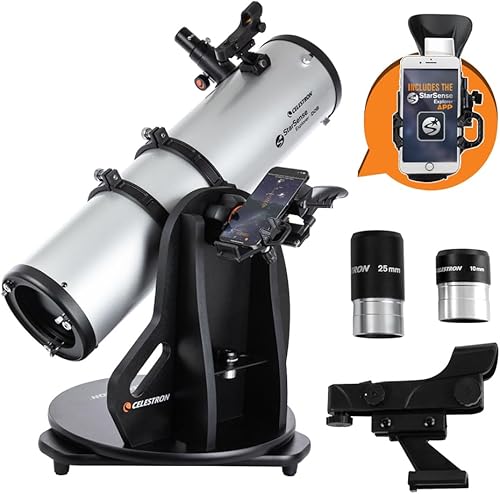
Celestron StarSense Explorer 150mm Tabletop Dobsonian
A 150mm tabletop Dobsonian with phone-guided finding. Light, simple, and a guide for finding targets.
- Aperture
- 150 mm (6 inch)
- Design
- Tabletop Dobsonian
- Mount
- Manual tabletop with StarSense app
What works
- 6-inch aperture at a mid-range price
- Phone app helps you find targets
- Compact and easy to carry
Watch for
- Needs a table or sturdy surface
- No tracking
Best for: an app-guided scope you can carry
Gskyer 70mm AZ Refractor: lightest and lowest cost
The Gskyer 70mm is a small, light refractor that is quick to set up. It is the easiest scope here to carry on a hike or pack in a suitcase. It has a very large number of buyer ratings, and the listing includes extras like a phone adapter.
The aperture is small, so you will see less detail, and the mount is light. It is fine for the Moon and bright planets, and it makes a good travel scope for casual looking.
Buy it if weight and cost matter most. Skip it if you want deep-sky views.
Lightest and lowest cost
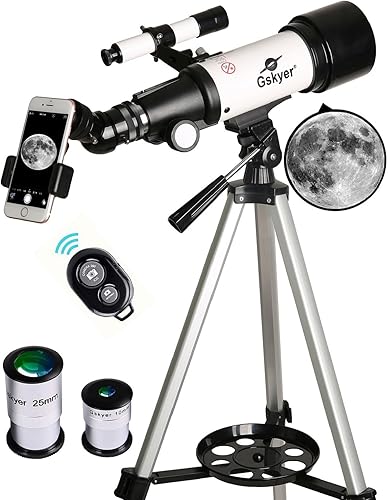
Gskyer 70mm AZ Refractor Telescope
A 70mm refractor that is easy to carry and set up. Small aperture, with a very large base of buyers.
- Aperture
- 70 mm
- Design
- Refractor
- Mount
- Alt-azimuth
What works
- Very low price
- Light and quick to set up
- Fine for the Moon and bright planets
Watch for
- Limited light-gathering
- Lightweight mount can wobble
Best for: a very low-cost starter
Celestron StarSense Explorer LT 114AZ: portable and guided
The LT 114AZ is a 114mm reflector on a lightweight tripod, with phone-guided finding. It is more compact than a large Dobsonian, and the app helps you find targets. It is easy to set up and move.
The tripod is light, so handle it gently. It is a decent balance of portability, guidance and price.
Buy it if you want guided finding in a light package. Skip it if you want more aperture.
Portable and guided

Celestron StarSense Explorer LT 114AZ
A 114mm reflector with phone-guided finding on a lightweight tripod.
- Aperture
- 114 mm (4.5 inch)
- Design
- Newtonian reflector
- Mount
- Alt-azimuth with StarSense app
What works
- Phone app guides you to targets
- Low price for the feature
- Very popular with first-time buyers
Watch for
- Small aperture limits faint objects
- Light mount needs careful handling
Best for: the lowest-cost app-guided scope
Celestron NexStar 5SE: best portable with tracking
The 5SE is the heaviest option here, but it is compact for what it does. A short, folded optical tube and a single-arm mount mean a smaller package than a long-tube scope of the same aperture. It finds and tracks objects for you.
It needs power and alignment, and it costs more. If you want a portable scope that does the work, it is a strong choice. See telescopes that find objects for you.
Buy it if you want tracking in a portable scope. Skip it if you want the lightest, cheapest option.
Best portable with tracking

Celestron NexStar 5SE Telescope
A compact 5-inch computerized scope. Heavier than the others, and it tracks objects for you.
- Aperture
- 125 mm
- Design
- Schmidt-Cassegrain
- Mount
- Computerized alt-azimuth GoTo
What works
- Compact and portable
- GoTo mount saves time
- Sharp views of the Moon and planets
Watch for
- Smaller aperture than the 8SE
- Higher price than basic scopes
Best for: portable GoTo with good optics
Side-by-side specs
| Model | Aperture | Design | Mount | Price |
|---|---|---|---|---|
| Sky-Watcher Heritage 150 Tabletop Dobsonian | 150 mm (6 inch) | Collapsible tabletop Dobsonian | Manual tabletop alt-azimuth | From about $309 |
| Celestron StarSense Explorer 150mm Tabletop Dobsonian | 150 mm (6 inch) | Tabletop Dobsonian | Manual tabletop with StarSense app | From about $510 |
| Gskyer 70mm AZ Refractor Telescope | 70 mm | Refractor | Alt-azimuth | From about $97 |
| Celestron StarSense Explorer LT 114AZ | 114 mm (4.5 inch) | Newtonian reflector | Alt-azimuth with StarSense app | From about $240 |
| Celestron NexStar 5SE Telescope | 125 mm | Schmidt-Cassegrain | Computerized alt-azimuth GoTo | From about $899 |
Setting up fast at a dark site
Speed matters when you are tired and it is cold. A good routine makes it faster. Carry the scope in one trip, with the eyepieces and finder already attached or packed in a small bag. Set the base on a stable surface and check that it does not rock. Remove the dust cap, point the scope at a distant light or the horizon and align the finder on it. Then wait for the scope to cool while you let your eyes adapt to the dark.
If you use a tabletop scope, level the table or use a small piece of foam to stop wobble. Dew can form on the optics on cool, damp nights, so a dew shield on a reflector or refractor, a simple tube of cardboard or foam, helps. Keep your phone's brightness down or use a red-light mode so that you do not ruin your night vision.
What to look at on a short trip
Portable scopes shine on trips because the sky is darker. Start with the Moon if it is up, then move to planets and the brightest clusters. If the Moon is down, a dark site opens up the Milky Way, and a scope that shows star clouds and large clusters will be a treat. Use a low-power eyepiece, since it gives a wide field and a brighter image, and it makes finding objects easier.
An app or printed star chart helps a lot in an unfamiliar sky. Plan a short list of targets before you go so that you spend your time observing instead of searching. Our guide to what you can see through a telescope lists good first targets.
Portability and stability
The lighter the scope, the more careful you have to be with the mount. Tabletop designs rely on the surface under them, and very light tripods flex when you touch them. Move the scope gently, wait a moment for the image to settle after each nudge and avoid touching the focuser more than you must. If wind is an issue, set up in the lee of a car or a wall. A little care turns a modest scope into a satisfying one.
Packing and travel tips
Protect the optics. Wrap the tube in a towel or foam, and keep the caps on. Mirrors and lenses can be knocked out of alignment by bumps.
Pack the small parts together. Eyepieces, the finder, a red flashlight and any cables go in a labeled bag.
Bring a stable surface. If you have a tabletop scope, a small folding table is a good addition.
Plan for cooling. Set up early so the scope matches the outside air.
Bring warm clothes and a chair. Comfort extends your night.
Why a dark site beats a bigger scope
A portable scope under dark skies shows more than a large scope in the city. The Milky Way becomes visible, and fainter galaxies and nebulae come into reach. If your home sky is bright, see telescopes for light-polluted skies for more.
Choosing between a tabletop and a tripod
A tabletop scope is the most compact, and it relies on a surface. A tripod scope is a bit larger, and it stands on its own. If you often travel to places without a table, a tripod scope is the safer choice. If you have a sturdy table or a car with a flat surface, a tabletop scope gives you more aperture in the same space. Think about where you will use it, and pick the design that fits.
Shopping for someone else? See our telescope gift guide.
How we chose these telescopes
We compared weight, size, setup time, aperture and owner feedback on the listings. This is research, not hands-on testing. Prices come from Amazon and are stamped with the time they were checked. Our about page and affiliate disclosure explain how we work.
Which one should you buy?
For most people, buy the Heritage 150. Add the StarSense 150mm tabletop for guidance, the Gskyer for the lightest option and the NexStar 5SE for tracking. For small homes, see telescopes for apartments and small spaces.
Frequently asked questions
What is the most portable telescope?
Small refractors and collapsible tabletop Dobsonians are the easiest to carry. Compact catadioptrics are the most portable per inch of aperture.
Can I take a telescope on a plane?
Many people do, usually as carry-on if it fits, or checked with good padding. Check the airline's size rules and the weight of your scope.
How much aperture do I lose with portability?
Less than you might think. A collapsible 6-inch is far more portable than a fixed-tube one and gives up nothing optically.
Do portable telescopes need a table?
Tabletop models do. A sturdy folding table, a rock or a car hood works, as long as it is stable.
Are portable telescopes good for dark-sky trips?
Yes. A scope you will carry to a dark site often shows more than a bigger scope that stays home.
What is the best portable telescope for travel?
A compact refractor or a small tabletop scope is easiest to pack. They give up some aperture, but a telescope you actually bring along beats a bigger one left at home.
Do portable telescopes work well for the Moon and planets?
Yes. The Moon and planets are bright, so even small apertures show craters, Jupiter's bands and Saturn's rings. Faint galaxies are where portable scopes struggle.
Can I carry a telescope as hand luggage?
Often yes for small refractors and tabletop scopes, but airline rules vary, so check yours. Pack the optics in a padded bag and keep the mount with the main luggage if it is bulky.
Keep reading
Types and Mounts Best Telescopes for Apartments and Small Spaces: Four Picks Four telescopes for apartments, balconies and small homes, picked for size, storage and setup time, with honest advice on what you can see from a balcony. 7 min read · Updated Nov 9, 2026 Best Telescopes Best Telescopes for Beginners: Five Picks That Show Real Detail Five beginner telescopes compared by aperture, mount, setup and price, with plain advice on what you will actually see and who should skip each one. 10 min read · Updated Oct 17, 2026  Types and Mounts Best Dobsonian Telescopes: Four Picks From Tabletop to 10-Inch Four Dobsonian telescopes compared by aperture, portability and price, with honest advice on which size fits your car, your storage and your sky. 8 min read · Updated Oct 20, 2026